Portable RAID enclosures make it easier to combine multiple SATA or NVMe drives into a faster, more flexible external storage system. They can support RAID 0 for speed, RAID 1 for redundancy, JBOD for separate disks, or standard drive access depending on the model.
This roundup includes compact dual-bay designs, multi-drive HDD enclosures, and hybrid systems for photographers, creators, home-office users, and anyone who needs more control than a typical external hard drive provides.
Best 10 Portable Raid Enclosures Picks for 2026
Best Compact RAID Pick

- USB 3.2 Gen 2 up to 10Gbps
- Two-bay hardware RAID enclosure
- Tool-free trays with temperature-controlled fan
Best For: Compact desktop storage and mirrored backups
Best High-Capacity RAID Pick

- Five 3.5-inch SATA drive bays
- Eight RAID and storage modes
- Up to 110TB stated capacity
Best For: Large media libraries and multi-drive backups
Best Hybrid Storage Pick
CENMATE 5-Drive Hybrid Enclosure

- Two SATA bays plus three M.2 NVMe slots
- USB 3.2 Gen 2 with USB-A/C support
- Up to 68TB stated combined capacity
Best For: Mixed HDD, SATA SSD, and NVMe storage setups
Best Four-Bay Workhorse

- Four 3.5-inch SATA drive bays
- Eight RAID and storage modes
- Two switch-controlled cooling fans
Best For: Professional desktop backups and media storage
Best for NVMe Cloning

- RAID 0/1, JBOD, and Clone modes
- Tool-free M.2 2280 installation
- 20Gbps USB 3.2 transfers
Best For: Portable NVMe cloning and redundant backups
Best Compact SATA Option
CineRAID CR-H218P Dual-Bay Enclosure

- Two-bay 2.5-inch SATA support
- 10Gbps USB 3.1 Gen 2 connectivity
- RAID 0/1, JBOD, and Normal modes
Best For: Portable SATA storage for gaming and creative work
Best with Extra Features
Vantec NexStar GX Dual-Bay Enclosure

- Fits two 2.5-inch SATA drives
- Supports Individual, RAID 0, and RAID 1
- USB 3.0 with aluminum ventilated housing
Best For: Portable 2.5-inch SSD or HDD RAID setups
Large-Drive Workstation Choice

- Accepts 2.5-inch and 3.5-inch SATA drives
- Offers four RAID and disk modes
- Includes fan and USB-A/C 3.0 connectivity
Best For: High-capacity desktop or business storage arrays
Travel-Friendly 2.5-Inch Option
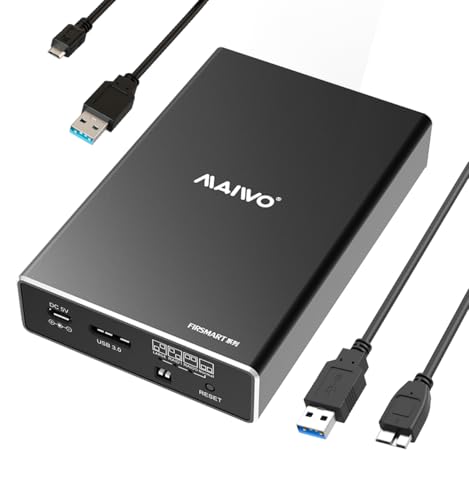
- Supports two 2.5-inch SATA drives
- Provides four selectable disk modes
- Compact aluminum body with USB 3.0 and UASP
Best For: Portable paired-drive storage and RAID setups
Best Compact RAID Pick – TerraMaster D2-320
For shoppers seeking portable RAID enclosures without a large multi-bay footprint, the TerraMaster D2-320 offers a straightforward two-drive DAS design. Its USB 3.2 Gen 2 connection, hardware RAID modes, and tool-free trays make it practical for desktop backups and expandable storage.
Best For: Users who need a compact two-bay enclosure with RAID 0, RAID 1, JBOD, and Single modes.
Pros:
- USB 3.2 Gen 2 supports data transfer up to 10Gbps.
- Supports two 3.5-inch or 2.5-inch SATA HDDs or 2.5-inch SATA SSDs.
- RAID 1 can mirror data and automatically rebuild after a replacement drive is installed.
- Tool-free push-lock trays and temperature-controlled cooling simplify installation and operation.
Cons:
- Only accommodates two drives.
- It is a direct-attached storage enclosure, not a NAS.
- Drives are not included.
The D2-320 is a balanced choice when you want fast USB connectivity and basic RAID flexibility in a smaller enclosure. Its two-bay capacity is more suited to personal backups and media storage than large-scale expansion.
Best High-Capacity RAID Pick – ORICO 5-Bay RAID Enclosure
The ORICO 5-Bay is designed for buyers who need substantial desktop capacity from portable RAID enclosures. With support for five 3.5-inch SATA drives, eight configuration modes, and a 150W built-in power supply, it suits demanding backup and media-storage setups.
Best For: Large storage libraries, engineering projects, and high-resolution video collections requiring up to 110TB of stated capacity.
Pros:
- Offers eight modes, including RAID 0, 1, 3, 5, 10, JBOD, Clone, and Clear.
- Supports five 3.5-inch SATA drives, with up to 22TB per disk.
- Aluminum construction, front and rear vents, and an 80mm silent cooling fan aid heat management.
- Built-in 150W power supply supports multiple drives without a separate power brick.
Cons:
- USB 3.0 transfer speeds are rated up to 5Gbps, slower than newer 10Gbps enclosures.
- Designed for 3.5-inch drives rather than a mix of drive sizes.
- Data should be backed up before switching RAID modes.
Choose the ORICO when drive count and capacity matter more than the latest USB performance. Its five bays and broad RAID selection provide room to build a flexible desktop storage array.
Best Hybrid Storage Pick – CENMATE 5-Drive Hybrid Enclosure
The CENMATE hybrid enclosure stands apart among portable RAID enclosures by combining two SATA drive bays with three M.2 NVMe slots. Its USB 3.2 Gen 2 interface and support for both USB-A and USB-C connections make it an adaptable option for users combining high-capacity HDD storage with compact SSDs.
Best For: Power users who want one enclosure for SATA drives and multiple M.2 NVMe SSDs.
Pros:
- Combines two 2.5-inch or 3.5-inch SATA drives with three M.2 NVMe SSDs.
- Supports RAID 0, RAID 1, Normal, and JBOD modes for the SATA storage section.
- USB 3.2 Gen 2 supports up to 10Gbps and includes USB-A and USB-C cables.
- Tool-free installation and built-in aluminum construction with continuous fan cooling.
Cons:
- The fan continuously cools the drives and may not suit users sensitive to sound.
- RAID configuration may result in data loss if set up incorrectly.
- Mac OS does not support the enclosure’s RAID software.
The CENMATE is the most flexible choice here for mixed storage hardware. Its unusual HDD-and-NVMe layout can reduce the need for separate enclosures, though the always-on fan and platform limitations deserve consideration.
Best Four-Bay Workhorse – MAIWO 4-Bay RAID Enclosure
For buyers who want more drive bays than a compact two-bay unit but do not need a five-bay enclosure, the MAIWO 4-Bay is a practical middle ground. It supports eight RAID and storage modes, USB-C connectivity, and up to four 3.5-inch SATA drives.
Best For: Professionals, businesses, and power users building desktop backup, surveillance, or media-storage systems.
Pros:
- Supports Normal, RAID 0, 1, 3, 5, 10, Clone, and Large/JBOD modes.
- Accommodates four 3.5-inch SATA drives with stated capacity up to 96TB.
- Includes USB-A-to-USB-C and USB-C-to-USB-C cables.
- Two switch-controlled cooling fans help manage drive temperatures during intensive use.
Cons:
- USB transfer speed is rated up to 5Gbps.
- Supports 3.5-inch SATA drives rather than a mix of drive form factors.
- Drives are not included.
The MAIWO offers a useful balance of capacity, RAID flexibility, and connectivity for a multi-drive desktop setup. It is a strong fit when four bays are sufficient and 5Gbps USB performance meets your workflow needs.
Best for NVMe Cloning – Dual-Bay RAID SSD Enclosure
This portable RAID enclosure is designed for two M.2 2280 NVMe SSDs and combines fast USB 3.2 connectivity with several storage modes. RAID 0, RAID 1, JBOD, and offline Clone mode make it a flexible option for backups, drive duplication, and high-speed file transfers.
Best For: Users who need portable NVMe storage, direct drive cloning, or RAID 1 redundancy for important files.
Pros:
- Supports RAID 0, RAID 1, JBOD, and Clone modes.
- Tool-free installation makes SSD replacement and cloning more convenient.
- 20Gbps transfer speeds suit large files and data-intensive tasks.
- Aluminum construction helps with heat dissipation while keeping the enclosure portable.
Cons:
- Designed for M.2 2280 NVMe SSDs rather than 2.5-inch drives.
- Two high-capacity SSDs may require the auxiliary USB-C input for stable operation.
Choose this model if NVMe compatibility and offline cloning are priorities. Its broad mode selection is useful, but it is more specialized than enclosures made for standard SATA drives.
Best for Mobile Media Workflows – ORICO 4-Bay All-Flash Enclosure
This portable RAID enclosure provides four bays for 2.5-inch SSDs or HDDs, plus card slots and USB expansion for on-location work. With seven RAID modes, support for up to 40TB across the bays, and a compact all-flash design, it targets photographers and video editors managing large project files.
Best For: Video editors, photographers, and mobile creators who need multi-drive storage and convenient card-based backups.
Pros:
- Offers RAID 0, 1, 3, 5, 10, JBOD, and CLEAR modes.
- Supports four 2.5-inch drives and up to 40TB total capacity according to the supplied specifications.
- Includes two 10Gbps USB ports plus SD and TF card slots.
- Compact, lightweight all-flash construction is suited to backpacks and camera bags.
Cons:
- Does not support 3.5-inch drives.
- Performance varies by interface, with the supplied notes listing up to 10Gbps through USB 3.2 Gen 2 and 5Gbps via SATA.
This is the most expandable option of the three for media workflows. Its multiple RAID choices and card connectivity add flexibility, though users with only one or two drives may not need its larger four-bay layout.
Best Compact SATA Option – CineRAID CR-H218P Dual-Bay Enclosure
This portable RAID enclosure supports two 2.5-inch SATA SSDs or HDDs and connects over USB 3.1 Gen 2 at up to 10Gbps. It includes RAID 0, RAID 1, JBOD, and Normal modes, while the TPU cover adds protection for users carrying the compact aluminum-style drive enclosure between locations.
Best For: Gamers and creators who want a simple dual-bay SATA enclosure for laptops, desktops, or console storage expansion.
Pros:
- Supports RAID 0, RAID 1, JBOD, and Normal modes.
- USB 3.1 Gen 2 offers up to 10Gbps transfers and remains backward compatible with USB 3.0 and 2.0.
- Supports drives up to 12.5mm thick.
- Includes a grey TPU cover for added portability and protection.
Cons:
- Limited to two 2.5-inch SATA drives.
- It does not offer the 20Gbps NVMe connectivity of the first enclosure or the four-bay capacity of the ORICO model.
The CR-H218P is a practical choice when compatibility with 2.5-inch SATA drives matters more than maximum capacity or newer NVMe performance. Its straightforward RAID selection and protective cover make it well suited to everyday portable use.
Best with Extra Features – Vantec NexStar GX Dual-Bay Enclosure
Vantec Nexstar GX USB 3.0 Dual 2.5" SATA SSD/HDD RAID Enclosure, Black (NST-272S3-BK)
Check Price On AmazonThe Vantec NexStar GX is a compact choice among portable raid enclosures for users with two 2.5-inch SATA SSDs or hard drives. It supports Individual, RAID 0, and RAID 1 modes, USB 3.0 speeds up to 5Gbps, UASP, and automatic RAID 1 rebuilding.
Best For: Laptop users and small desktop setups that need a portable dual-drive enclosure for 2.5-inch SATA storage.
Pros:
- Supports two 2.5-inch SATA I/II/III SSDs or HDDs.
- Offers Individual, RAID 0, and RAID 1 configurations.
- Aluminum housing with front vents helps dissipate heat.
- Includes an AC adapter, USB 3.0 cable, stand, and installation hardware.
Cons:
- Hard drives and SSDs are not included.
- Requires the included 5V/2A power adapter and may need additional power depending on the drives.
- Uses a USB Micro-B connector rather than a newer USB-C port.
Choose this model when compact dimensions, RAID 1 support, and compatibility with 2.5-inch SATA drives matter more than USB-C connectivity or support for larger 3.5-inch disks.
Large-Drive Workstation Choice – CENMATE 2-Bay RAID Enclosure
The CENMATE 2-Bay enclosure is a practical option among portable raid enclosures when you need support for both 2.5-inch and 3.5-inch SATA drives. Its four modes, aluminum body, built-in cooling fan, and USB-A/C 3.0 connectivity suit higher-capacity external storage setups.
Best For: Desktop and business users building a two-drive external array with large 3.5-inch HDDs or mixed-size SATA storage.
Pros:
- Supports two 2.5-inch or 3.5-inch HDDs and SSDs.
- Provides RAID 0, RAID 1, Normal, and JBOD modes.
- Supports up to 20TB per drive according to the supplied specifications.
- Includes a cooling fan and both USB-A and USB-C 3.0 cables.
Cons:
- Fan noise is rated around 40–50 decibels.
- Changing or resetting a RAID array can result in data loss if handled incorrectly.
- The notes indicate that macOS does not provide RAID software for this enclosure.
This is the more flexible pick for capacity-focused users, particularly those who want to use full-size 3.5-inch drives. Its fan improves cooling but makes it less appealing for noise-sensitive environments.
Travel-Friendly 2.5-Inch Option – MAIWO Dual-Bay RAID Enclosure
The MAIWO K25272 is a small, lightweight entry in portable raid enclosures for two 2.5-inch SATA SSDs or HDDs. It supports four selectable modes, UASP, USB 3.0 transfer speeds up to 5Gbps, tool-free installation, and hot swapping.
Best For: Mobile users who want a compact enclosure for paired 2.5-inch drives and straightforward RAID mode switching.
Pros:
- Supports 2.5-inch 7mm and 9.5mm SATA HDDs and SSDs.
- Offers Normal/PM, RAID 0, RAID 1, and Large/JBOD modes.
- Compact aluminum design measures about 5 by 3 by 1 inches and weighs 12 ounces.
- Includes data and independent power cables, screwdriver, and screws.
Cons:
- SSD or HDD storage is not included.
- Requires an additional power connection when in use.
- Capacity is limited to 6TB per bay, or 12TB total, according to the supplied specifications.
The MAIWO stands out when portability and broad mode support are priorities. Confirm that your drives fit the 2.5-inch bay size and plan for the separate power cable before choosing it for travel.
How We Picked These Portable Raid Enclosures
We selected models across the most useful enclosure formats, including dual-bay SATA units, four- and five-bay HDD systems, all-flash designs, and hybrid SATA/NVMe options. We considered drive compatibility, supported RAID modes, connection standards, cooling, installation convenience, capacity potential, and the needs of different budgets and workflows.
Because an enclosure does not normally include drives, the best choice depends on both the hardware you install and the way you plan to use the array. Specifications such as advertised speed and maximum capacity can also vary with the installed drives, host computer, cable, operating system, and RAID configuration.
Quick Comparison
| Type | Best For | What to Look For |
|---|---|---|
| Dual-bay SATA | Home backups and general storage | RAID 1, RAID 0, JBOD, UASP, USB-C |
| Four- or five-bay HDD | Large media libraries and expandable storage | Cooling, stable power, multiple RAID modes |
| Dual-bay NVMe | High-speed editing and file transfers | 20Gbps USB, PCIe compatibility, thermal control |
| Hybrid SATA/NVMe | Mixed-drive systems and experimentation | Drive-key support, bandwidth sharing, cooling |
| All-flash enclosure | Quiet, compact performance | SSD capacity, heat management, hub features |
Key Buying Factors for Portable Raid Enclosures
Drive Type and Bay Count
Check whether the enclosure accepts 2.5-inch SATA drives, 3.5-inch SATA hard drives, M.2 NVMe modules, or a combination. More bays allow greater capacity and additional RAID layouts, but they also increase size, power requirements, and cost.
RAID Modes and Data Protection
RAID 0 combines drives for higher performance but offers no redundancy. RAID 1 mirrors data for protection against a single drive failure, while JBOD presents drives individually. Some models also offer normal or spanning modes. RAID is not a substitute for a separate backup.
Connection Speed
USB 3.0 and 5Gbps connections are adequate for many hard-drive arrays. USB 3.1 or 10Gbps is more suitable for SATA SSDs, while 20Gbps connections can better serve high-performance NVMe storage. Confirm that your computer supports the advertised interface.
Cooling, Power, and Installation
Fans are especially valuable in multi-bay HDD enclosures and high-speed NVMe systems. Look for tool-free trays or mounting when convenience matters, and verify that the included power adapter can support the installed drives. Aluminum construction may help with heat dissipation, but active cooling is often more important under sustained workloads.
Who Should Buy Which Portable Raid Enclosures?
Choose a compact dual-bay SATA enclosure if you need simple backup storage, mirrored protection, or a flexible upgrade from a single external drive. A four- or five-bay model is better for large media collections, office archives, and users who want room to expand. Creators working with large project files should consider an NVMe or all-flash enclosure with a 10Gbps or faster connection. Hybrid models suit advanced users who already own different drive types and want one adaptable chassis.
Before buying, confirm the enclosure’s supported drive sizes, RAID controls, operating-system compatibility, cable type, and cooling design. Then select the RAID mode that matches your priorities and maintain an independent backup of important files.