The right sketchbook can make tattoo practice more purposeful by giving you a place to test scale, placement, proportions, and line quality before working on skin. Body templates are especially useful for visualizing how a design follows curves and changes with anatomy.
We compared 10 options ranging from realistic body imagery and tracing workbooks to large blank sketchbooks and structured practice trainers, so you can choose the format that matches your experience and workflow.
Best 10 Tattoo Sketchbook with Human Body Templates Picks for 2026
Realistic Template Pick
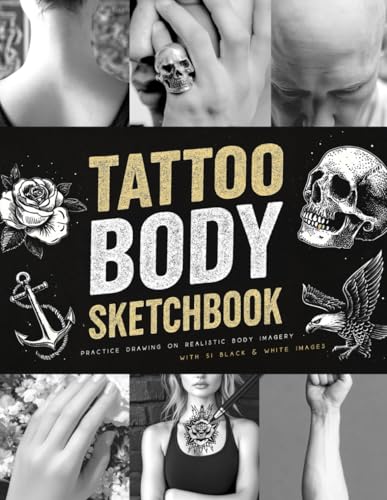
- 51 realistic black-and-white body images
- 100 pages with blank reverse pages
- Useful for ideas, lettering, and client work
Best For: Artists wanting realistic body-based tattoo practice
Paper Quality Pick

- 150 sheets of 65 lb. Canson paper
- Head-to-toe anatomical body parts
- Non-photo blue templates for visible artwork
Best For: Artists prioritizing paper quality and anatomy variety
Spacious Idea Book

- 120 large blank pages
- Three dot-graph pages for geometry
- Useful for concepts and client requests
Best For: Artists wanting open space for general tattoo ideas
Beginner Linework Pick

- Exercises basic shapes and line work
- Builds repetition-based muscle memory
- Supports transfer to practice tattoo skin
Best For: Beginners practicing control before tattooing
Best for Mexican-Inspired Reference Art
Cultura Tattoo Sketchbook (Tattoo-U)

- Features Tattoo Duke’s rendered designs, collages, and hand sketches
- Explores Mexican, Aztec, graffiti, and street-inspired themes
- Shows shading approaches in color and black-and-grey work
Best For: Artists seeking culturally focused tattoo reference material
Best for Technique Practice

- Provides a five-phase line, curve, stencil, and shading curriculum
- Uses single-sided drills with blank backing pages
- Adds fixed-orientation exercises and tattoo ergonomics guidance
Best For: Beginners building tattoo drawing control and muscle memory
Best for Body-Placement Planning
Tattoo Sketchbook and Journal VI

- Offers front, rear, and side head-and-neck templates
- Includes placement, color, sketch, and client-note sections
- Adds heavyweight paper and a blank table of contents
Best For: Artists organizing head-and-neck tattoo concepts and commissions
Fine-Line Tracing Practice
Ink & Trace Tattoo Tracing Book

- 140+ fine-line tattoo-inspired designs
- Matching references and tracing pages
- Light guide lines for controlled practice
Best For: Structured fine-line practice and tracing
Tattoo Planning Log
Professional Tattoo Artist Sketchbook

- Prompts for placement and project details
- Includes palette, design, and notes fields
- Compact 6 x 9-inch format
Best For: Organizing consultations, appointments, and tattoo plans
Portfolio Builder
Large Tattoo Design Sketchbook

- Large 8.5 x 11-inch drawing format
- Prompts for placement and client details
- 100 pages for tattoo projects
Best For: Building a tattoo design portfolio with organized project notes
Realistic Template Pick – Tattoo Body Sketchbook
Tattoo Body Sketchbook: Practice Drawing on Realistic Body Imagery with 51 Black & White Images
Check Price On AmazonIf you want a tattoo sketchbook with human body templates, this option focuses on realistic body imagery for developing designs with placement and flow in mind. It includes 51 black-and-white template images within a 106-page format, with blank reverse pages intended to help reduce ink bleed.
Best For: Tattoo artists and enthusiasts who want realistic templates for brainstorming, lettering, and refining client concepts.
Pros:
- Includes 51 realistic black-and-white body images.
- Provides 100 pages and blank reverse pages for additional working space.
- Supports tattoo practice, lettering, and relaxation drawing.
- Suitable for a range of skill levels.
Cons:
- The supplied details do not specify the exact body areas represented.
- It is independently published, so edition-specific production details may vary.
Choose this sketchbook if realistic body reference is more important to you than specialized paper specifications. Its combination of templates and open pages makes it a practical concept-development tool.
Paper Quality Pick – The Body Sketch Book
The Body Sketch Book: A Variety of Anatomical Body Parts to Sketch on from Head to Toe
Check Price On AmazonFor shoppers seeking a tattoo sketchbook with human body templates and a more specified drawing surface, The Body Sketch Book offers anatomical parts from head to toe. Its 150 sheets of acid-free, fine-textured 65 lb. Canson paper are printed in non-photo blue so artwork can stand out when reproduced.
Best For: Tattoo artists who want extensive anatomical coverage, durable dry-media paper, and templates for gestures, composition, perspective, and finished studies.
Pros:
- Contains 150 sheets of 65 lb. Canson paper.
- Uses acid-free, fine-textured paper for dry media.
- Offers a variety of anatomical body parts from head to toe.
- Non-photo blue printing helps artwork stand out when printed.
Cons:
- The 2015 publication date makes it an older edition.
- The supplied notes do not identify the book’s physical dimensions.
This is the strongest fit for buyers who prioritize paper quality and anatomical variety. It is especially versatile for artists developing everything from rough gestures to more finished tattoo concepts.
Spacious Idea Book – Tattoo Sketchbook
This large tattoo sketchbook is a useful choice for recording concepts, but it is less specialized than a tattoo sketchbook with human body templates. It provides 120 blank 8.5-by-11-inch pages plus three dot-graph pages, giving artists room for freehand ideas, geometric planning, and client requests.
Best For: Tattoo artists who want a roomy general-purpose design book with a small amount of dot-grid support for geometric work.
Pros:
- Includes 120 large blank pages.
- Offers three dot-graph pages for complex geometric designs.
- Can be used to organize client artwork requests.
- Large 8.5-by-11-inch format provides generous drawing space.
Cons:
- Does not include human body templates in the supplied description.
- The dot-graph section is limited to three pages.
- The notes do not specify paper weight or media compatibility.
Pick this book when flexibility and page count matter more than body-placement guides. For artists who already draw placement templates separately, it can serve as a straightforward idea and client-request organizer.
Beginner Linework Pick – Tattoo Tracing Workbook
This workbook is a practice-focused alternative to a tattoo sketchbook with human body templates. Rather than providing body imagery, it uses repetitive tracing exercises to build control over basic shapes and line work, with guidance for transferring traced or printed patterns to practice tattoo skin.
Best For: Beginners developing line control, muscle memory, and basic tattooing technique before working on practice skin.
Pros:
- Concentrates on foundational shapes and line work.
- Repetition is designed to support muscle-memory development.
- Patterns can be transferred to practice tattoo skin manually or with a stencil printer.
- Includes landscape-format pattern options for selected designs.
Cons:
- At 28 pages, it is much shorter than the other books listed.
- It is a tracing workbook rather than a body-template sketchbook.
- The supplied details do not mention human anatomy templates.
Consider this workbook as a skills companion, not a placement sketchbook. It makes the most sense for beginners who need structured linework repetition before moving on to body-based tattoo design.
Best for Mexican-Inspired Reference Art – Cultura Tattoo Sketchbook (Tattoo-U)
If you want a tattoo sketchbook with human body templates, this book takes a reference-focused approach instead. It collects Tattoo Duke’s rendered designs, collages, and hand sketches across Mexican, Aztec, Raza-style, graffiti, American Indian, gangsta, and street-inspired themes.
Best For: Artists and clients looking for Mexican-culture-inspired tattoo references, especially shaded black-and-grey or full-color concepts.
Pros:
- Includes both finished artwork and simpler sketches showing the design process.
- Covers a distinctive range of Mexican, Aztec, graffiti, and related cultural themes.
- Demonstrates shading in both color and black-and-grey styles.
Cons:
- It is primarily an art reference source rather than a blank planning journal.
- The supplied description does not mention human-body placement templates.
Choose this volume when visual inspiration and shading examples matter more than structured body-placement worksheets or commission tracking.
Best for Technique Practice – Tattoo Practice Workbook
For shoppers comparing a tattoo sketchbook with human body templates, this workbook is better suited to skill drills than body-placement planning. Its 120 pages build control progressively through line work, curves, corners, stencil tracing, and shading exercises.
Best For: Aspiring tattoo artists practicing hand control, lining, tracing, shading, and machine-oriented drawing mechanics on paper.
Pros:
- Uses a five-phase progression from basic lines to shading and texture.
- Single-sided exercises and blank backing pages help limit bleed-through.
- Includes stencil motifs, shading grids, ergonomics guidance, and practical tips.
- Fixed-orientation drills are designed to simulate working on an arm or leg.
Cons:
- The supplied details do not list human-body outline templates for designing placement.
- It focuses on repetitive practice rather than keeping commission details or finished concepts.
- The listed publication date is July 19, 2026.
This is a practical choice for building foundational tattooing motions before moving to synthetic skin or machine practice, but it is not the strongest match for body-template-based design organization.
Best for Body-Placement Planning – Tattoo Sketchbook and Journal VI
Among these options, this is the closest fit for a tattoo sketchbook with human body templates. It combines more than 100 pages of heavyweight paper with head-and-neck views, design space, placement planning, color notes, and client-detail organization.
Best For: Tattoo artists and students who need a dedicated place to plan head-and-neck designs, record commissions, and organize client notes.
Pros:
- Includes front, rear, and side head-and-neck templates plus a detail page.
- Provides space for placement, color palette, tattoo sketches, and written notes.
- Includes a blank table of contents for organizing designs.
- Uses more than 100 pages of high-quality, heavyweight white paper.
Cons:
- The listed templates focus on the head and neck rather than the entire human body.
- Its predesigned format offers less completely open space than a blank sketchbook.
This is the most workflow-oriented choice in the group and a strong match if head-and-neck placement, client communication, and design records are central to your process.
Fine-Line Tracing Practice – Ink & Trace Tattoo Tracing Book
If you want a tattoo sketchbook with human body templates for structured linework practice, this tracing-focused option provides a guided alternative to starting from a blank page. It pairs finished color references with matching tracing pages and includes more than 140 tattoo-inspired designs.
Best For: Beginners, hobbyists, and artists developing fine-line control, smoother outlines, and steadier hand movement.
Pros:
- Includes 140+ designs across botanical, celestial, animal, symbolic, and flash themes.
- Pairs finished color references with matching tracing pages.
- Light 2H-pencil-style guide lines support step-by-step tracing.
- Clean white tracing areas allow optional coloring and personalization.
Cons:
- It is centered on tracing pages rather than human-body placement templates.
- Its 81-page format may offer less room for extended project documentation than a dedicated logbook.
This is the strongest choice of the three for guided fine-line repetition and studying finished designs, but shoppers specifically seeking body-placement templates should note that the supplied description does not list them.
Tattoo Planning Log – Professional Tattoo Artist Sketchbook
For shoppers comparing a tattoo sketchbook with human body templates, this compact artist logbook is better suited to organizing consultations, appointments, placement details, and tattoo plans. Its prompted fields help keep project information together while you sketch and take notes.
Best For: Professional tattooists and students who need a portable planning and record-keeping notebook.
Pros:
- Includes dedicated fields for placement, theme, planned date, palette, design details, and notes.
- Combines appointment, consultation, sketch, and project information in one place.
- Compact 6 x 9-inch size is easy to store or carry.
Cons:
- The supplied description does not specify human-body templates or illustrated placement figures.
- Its 100-page format and compact dimensions may provide less drawing space than a larger sketchbook.
Choose this book when project organization matters more than expansive drawing space. It can support placement planning, but the listed features do not confirm body-outline templates.
Portfolio Builder – Large Tattoo Design Sketchbook
If you are looking for a tattoo sketchbook with human body templates, this large workbook offers a practical space for recording design concepts, placement information, client details, and portfolio projects. Its prompted layout is designed to support a more complete tattoo-design workflow.
Best For: Tattooists, students, beginners, and artists building a documented design portfolio.
Pros:
- Large 8.5 x 11-inch format provides a substantial workspace.
- Includes prompts for project dimensions, client information, sessions, palette, placement, and notes.
- Offers 100 pages for documenting tattoo projects and design ideas.
- Quality white paper and a matte cover suit regular sketching and record keeping.
Cons:
- The supplied description says it includes blank templates but does not specifically confirm human-body outlines.
- Its prompted project format may feel less suitable for completely unrestricted sketching.
This is the most spacious option for combining sketches with project documentation. Before buying, verify the interior template style if human-body placement figures are essential to your search.
How We Picked the Best Tattoo Sketchbook with Human Body Templates
We focused on how effectively each book supports tattoo-specific practice rather than general drawing alone. Important criteria included the presence and usefulness of body templates, page size, paper format, tracing support, anatomy coverage, space for notes, and suitability for repeated exercises. We also considered whether a book is better for beginners learning control or experienced artists planning original compositions.
A good Tattoo Sketchbook with Human Body Templates should help you move from an idea to a workable placement plan. Books with realistic figures or anatomical parts are useful for proportion and positioning, while blank, dot-grid, or tracing pages offer more freedom for developing finished designs.
Quick Comparison
| Best For | Look For | Most Useful Format |
|---|---|---|
| Body placement | Realistic figures and multiple views | Body-template pages |
| Beginners | Guided exercises and tracing references | Structured workbook |
| Fine-line practice | Clear reference artwork and matching pages | Tracing workbook |
| Original design work | Large pages and minimal restrictions | Blank sketchbook |
| Portfolio planning | Room for concepts, notes, and revisions | Large-format artist book |
Key Buying Factors for a Tattoo Sketchbook with Human Body Templates
Template Quality and Coverage
Check whether the book includes full-body figures, individual anatomical areas, or both. Multiple angles and body types provide more practical value than a single repeated outline. Clear, uncluttered templates are easier to trace and annotate.
Paper Size and Layout
Large pages are preferable for sleeves, back pieces, legs, and detailed compositions. Smaller formats are easier to carry and can work well for flash concepts. Consider whether facing pages, dot grids, or blank sheets suit the way you plan.
Tracing and Practice Structure
Tracing pages can build confidence with line flow, spacing, and placement, but they should complement—not replace—freehand practice. Guided exercises are valuable for beginners who need repeatable drills for outlines, curves, corners, and consistent pressure.
Reference and Note Space
Look for room to record needle groupings, color ideas, stencil notes, revisions, or client-placement details. This turns the book into a working design archive rather than a collection of disconnected drawings.
Who Should Buy Which Tattoo Sketchbook with Human Body Templates?
Choose a body-template sketchbook if your main challenge is visualizing designs on anatomy. Beginners may benefit most from a tracing workbook or structured muscle-memory trainer, especially when learning steady lines and controlled curves. Artists focused on fine-line work should prioritize clear references with matching tracing pages.
If you already have reliable drawing skills, a large blank or dot-grid sketchbook offers greater flexibility for original flash, custom concepts, and portfolio development. Professionals and students planning complete compositions should favor generous page dimensions, durable construction, and enough space for notes and revisions.