The best printmaking presses for small studios balance usable pressure, manageable footprints, and reliable registration without demanding a full commercial workspace. This roundup compares ten manual options for linocut, relief, etching, copperplate, woodblock, and mixed-media projects.
Before choosing, consider the formats you print most often, the amount of hand effort you can manage, and whether the press must share a table with other studio equipment. The buying guide below highlights the practical differences that matter most.
Best 10 Printmaking Presses for Small Studios Picks for 2026
Best Compact Engraving Press

- 310 x 170 mm print area
- Supports intaglio, relief, and woodblock work
- Compact aluminum-and-steel construction
Best For: Mixed printmaking in small studios and home workshops
Best Entry-Level Lino Press

- Compact 8.7 x 6-inch format
- Steel frame with beech handle
- Includes brayer and felt sheet
Best For: Beginners making small linocut and relief prints
Best Versatile Etching Press

- Handles prints up to 9 x 15 inches
- Supports multiple printmaking techniques
- Includes felt pad and base plate
Best For: Beginners and shared studios needing process flexibility
Best Adjustable Linocut Press

- Three adjustable pressure levels
- Accepts blocks up to 25 mm thick
- 304 stainless steel frame with felt pad
Best For: A4 linocut work and thicker blocks in compact studios
Compact Versatility
Multipurpose Desk Engraving Press

- Supports multiple engraving and relief techniques
- Compact 31 x 17 cm tabletop plate
- Adjustable roller with sturdy metal construction
Best For: Small studios needing a versatile press for small-format artwork
Large Manual Capacity

- Offers an 11.8 x 19.7-inch printing area
- Operates manually without electricity
- Detachable components support easier moving
Best For: Studios and classrooms needing a larger manual etching area
Effort-Saving Linocut

- Handles blocks up to about 25 mm thick
- Works with A4-size paper
- Includes pads, roller, and basic tools
Best For: Small studios focused on accessible linocut and block printing
Large-Format Studio Pick
BEILOCKERY Manual Slab Roller Press
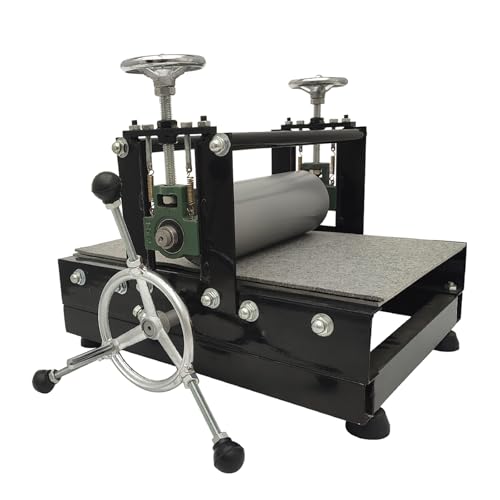
- 19.7-by-12.6-inch workspace
- Adjustable roller height
- Iron build with stable feet
Best For: Larger copperplate, woodblock, and relief projects
Durable Etching Option
Basic All-Metal Printing Press

- All-metal construction
- Supports etching and embossing
- Approximately 11-by-10-inch area
Best For: Tabletop etching, embossing, and block printing
Portable Starter Pick
Lounsweer Adjustable Block Press

- Weighs about 5.17 pounds
- Handles prints up to 6 by 8 inches
- Adjustable steel hand press
Best For: Portable linocut, woodcut, and letterpress projects
Best Compact Engraving Press – Tabletop Manual Etching Press
For makers comparing printmaking presses for small studios, this tabletop manual press offers a relatively large 310 x 170 mm print area while keeping its footprint compact. Its aluminum alloy body, steel table, and hand-crank operation suit woodblocks, copperplates, intaglio, relief work, and other pressed artwork.
Best For: Small studios and home workshops needing a compact press with broad technique compatibility.
Pros:
- Print area accommodates work up to 310 x 170 mm.
- Supports intaglio, letterpress, relief, woodblock, and copperplate printing.
- Aluminum alloy body and thickened steel table provide a stable structure.
- Compact tabletop dimensions take up limited workspace.
Cons:
- Manual operation requires hand-cranking for each print.
- Its 17.6-pound weight may still make frequent relocation inconvenient.
This is a versatile option when a small studio needs more process flexibility than a dedicated linocut press provides. The stated print area and sturdy construction make it especially useful for mixed printmaking projects.
Best Entry-Level Lino Press – A5 Green Linocut Press
For printmaking presses for small studios focused on block printing, this A5 tabletop lino press provides a straightforward manual setup. The powder-coated steel frame, beech wood handle, plywood plates, included brayer, and felt sheet cover the basic needs of linocut, relief, and rubber-block projects.
Best For: Beginners and small workspaces producing A5-size linocut and relief prints.
Pros:
- Designed for lino, woodcut, relief, and rubber-block printing.
- Compact A5 format measures 8.7 by 6 inches.
- Steel frame and beech handle provide manual pressure control.
- Includes a 6 cm rubber brayer and felt sheet.
Cons:
- The A5 size limits the scale of projects compared with larger listed versions.
- Its plywood plates may offer less substantial construction than a full metal press.
This press is a practical starter choice for artists who primarily make smaller block prints. The included accessories reduce the need for immediate add-on purchases, while the available larger sizes provide an upgrade path within the same style of press.
Best Versatile Etching Press – Basic Press with Felt Pad
Among printmaking presses for small studios, this basic etching machine stands out for supporting several processes in a compact footprint. It handles prints up to 9 x 15 inches and includes a felt pad and base plate, making it suitable for etching, embossing, monotype, lithography, block printing, and relief work.
Best For: Home studios, schools, workshops, and beginners who want one press for multiple techniques.
Pros:
- Supports prints up to 9 x 15 inches.
- Works with etching, embossing, block printing, monotype, lithography, and relief printing.
- Includes a felt pad and base plate for immediate setup.
- Heavy-duty steel construction and smooth roller support even pressure.
Cons:
- Its 18.5-pound weight may be cumbersome to carry regularly.
- The compact dimensions may limit larger-format work beyond the stated print size.
This is a strong all-around candidate when versatility matters more than specialization. The rotating L-shaped handle, included cushioning, and broad technique range make it approachable for shared studio or instructional use.
Best Adjustable Linocut Press – A4 Beech Wood Lever Press
For small studios seeking printmaking presses with adjustable pressure, this A4 linocut press combines a compact tabletop design with three pressure settings. Its 304 stainless steel frame, beech wood pressure plate and handle, felt pad, and support for blocks up to 25 mm thick make it suitable for linocut, woodcut, letterpress, rubber printing, and crafts.
Best For: Beginners, classrooms, and artists who need adjustable pressure for thicker carving blocks.
Pros:
- Three pressure levels accommodate different materials and blocks.
- Handles carving blocks up to 25 mm thick and standard A4 paper.
- 304 stainless steel frame resists shaking, deformation, and corrosion.
- Felt pad helps protect blocks and support even ink transfer.
Cons:
- Its 13.5 x 13-inch footprint may require dedicated tabletop space.
- Manual lever operation is less suitable for users seeking powered pressing.
This press is particularly compelling for artists who work with varied block thicknesses. Adjustable pressure and the wear-resistant shaft sleeve support smoother lever use, while the 13-pound build remains manageable for a tabletop studio setup.
Compact Versatility – Multipurpose Desk Engraving Press
For artists comparing printmaking presses for small studios, this compact manual model offers a 31 x 17 cm plate for relief, lino, wood, copper, and other engraving projects. Its adjustable roller is designed to help distribute pressure evenly in a home, classroom, or space-conscious studio.
Best For: Artists, students, and hobbyists who need a compact press for varied paper and engraving work.
Pros:
- Supports hollow, embossed, wood, typographic, lino, scrub, and copper engraving techniques.
- Compact tabletop design suits desks, classrooms, and small creative spaces.
- Adjustable roller height helps accommodate different materials and pressure needs.
- Aluminum alloy plate and reinforced steel frame are designed for stability and rust resistance.
Cons:
- The 31 x 17 cm plate limits the size of work that can be printed.
- Manual operation requires the user to control the pressure and roller movement.
This is a practical choice when versatility and a small footprint matter more than a large working area. It is particularly suitable for studios handling varied small-format engraving and relief projects.
Large Manual Capacity – Tabletop Etching Press
This professional-style manual etching press is a strong contender among printmaking presses for small studios that need a larger 11.8 x 19.7-inch working area. It uses no electricity, and its adjustable roller lets users tune the thickness for different pressed artworks.
Best For: Home users, schools, DIY printmaking shops, and studios working on larger plates or relief projects.
Pros:
- Provides an 11.8 x 19.7-inch, or 30 x 50 cm, printing area.
- Manual operation allows users to control the working speed without electricity.
- Adjustable roller accommodates different thickness requirements.
- Detachable frame, hand wheel, and panel make the machine easier to move.
Cons:
- At approximately 19.15 kg, it is substantially less portable than lighter tabletop presses.
- The larger cast-iron construction may require more dedicated workspace.
- Manual operation requires physical effort during printing.
Choose this model when a generous printing area is a priority. Its cast-iron body and adjustable roller favor users who want a more substantial manual press for teaching, studio, and home applications.
Effort-Saving Linocut – Hand Lever Block Press
For printmakers seeking printmaking presses for small studios, this hand lever model is tailored to linocut and block work. It accommodates blocks up to about 25 mm thick and A4-size paper, while its three-level adjustment and included felt pad support more even, protected pressing.
Best For: Linocut, woodcut, letterpress, rubber, cork, and other small-format block-printing projects.
Pros:
- Three-level adjustment supports blocks up to approximately 25 mm thick.
- Compatible with A4-size printing, felt, and art papers.
- Lever design is intended to reduce effort and transmit pressure evenly.
- Includes a rubber roller, felt pad, rubber pad, and wrenches.
Cons:
- Blocks are not included.
- The approximately 12 x 11.5-inch press is aimed at smaller work rather than oversized prints.
- Its plywood pressure plate may be less suitable for users seeking an all-metal press.
This press makes sense for beginners, teaching environments, and compact studios focused on block printing. The included cushioning and straightforward lever operation add convenience for repeated linocut work.
Large-Format Studio Pick – BEILOCKERY Manual Slab Roller Press
For small studios that need room for larger work, this BEILOCKERY press combines a 19.7-by-12.6-inch workspace with adjustable roller height. Its iron construction and handwheel-driven operation make it a practical option among printmaking presses for small studios handling copperplate, woodblock, and relief projects.
Best For: Artists and teaching studios working on larger copperplate, woodblock, and paper prints.
Pros:
- Spacious 19.7-by-12.6-inch work area accommodates larger plates and blocks.
- Adjustable roller height supports different substrates and printing requirements.
- Iron construction, non-slip feet, and a large-diameter handwheel promote stable, controlled operation.
Cons:
- Its approximately 19.7-by-13.8-by-16.1-inch footprint may require dedicated tabletop space.
- Manual operation requires turning the handwheel for each print.
This is the strongest fit of the three when workspace and material flexibility matter more than portability. Measure your table before buying, especially if your studio is particularly compact.
Durable Etching Option – Basic All-Metal Printing Press
This compact all-metal press is designed for artists who want one machine for etching, embossing, block printing, and monochrome work. With an approximately 11-by-10-inch printing area and a 25-pound weight, it offers a sturdy choice among printmaking presses for small studios.
Best For: Printmakers seeking a durable tabletop press for etching, embossing, and block-printing projects.
Pros:
- All-metal construction is built for durable, repeated use.
- Supports etching, embossing, block printing, and other listed techniques.
- Provides an approximately 11-by-10-inch work area for varied project sizes.
Cons:
- At 25 pounds, it is less convenient to move than a lightweight hand press.
- The compact printing area is more limiting for oversized work.
- The supplied notes describe it primarily for monochrome printing.
Choose this model when robust construction and technique versatility are priorities. Its heavier build suits a dedicated work surface, while the moderate bed size keeps it relevant for many small-studio projects.
Portable Starter Pick – Lounsweer Adjustable Block Press
For artists short on space or frequently working away from the studio, the Lounsweer offers a compact, 5.17-pound format for prints up to 6 by 8 inches. Its adjustable height and pull-handle operation make it an approachable entry among printmaking presses for small studios, classrooms, and home use.
Best For: Linocut, woodcut, ink block printing, and letterpress projects up to 6 by 8 inches.
Pros:
- Lightweight 5.17-pound design is easy to transport.
- Adjustable height accommodates different printing surfaces.
- Steel construction supports hard and soft substrates.
Cons:
- The 6-by-8-inch maximum print size limits larger compositions.
- A rubber or carpet mat is recommended to protect the work surface.
- Its hand-operated format may be less suitable for high-volume production.
This is the most portable and space-conscious choice in the group. It makes sense for beginners, mobile makers, and small studios focused on modestly sized relief and letterpress work rather than large-format printing.
How We Picked These Printmaking Presses for Small Studios
We focused on manual presses suited to home workshops, teaching spaces, and compact artist studios. The selection covers tabletop etching presses, hand-lever linocut machines, slab-style presses, and multipurpose models. We considered stated print area, construction, pressure control, portability, included plates or felts, and the types of printing each design is intended to support.
Because specifications vary widely between sellers, verify dimensions, maximum paper size, roller or platen travel, and included accessories before ordering. A press described as “A4” or “A5” may refer to its working area rather than its overall footprint.
Quick Comparison
- Best for beginners: Small linocut presses with simple hand-lever operation and a limited working area.
- Best for mixed techniques: Tabletop etching presses with a base plate and felt, provided their pressure range suits your materials.
- Best for larger work: The widest slab-roller or professional-style options in the selection.
- Best for portability: Compact manual models that can be stored between sessions.
Key Buying Factors for Printmaking Presses for Small Studios
Working Area and Studio Footprint
Match the press bed to your typical block or plate size, not an occasional oversized project. Measure your table, storage area, and clearance for handles or rollers. A slightly smaller press is often more useful than a large machine that is difficult to set up.
Pressure and Control
Adjustable pressure helps accommodate different paper weights, block heights, plates, and blankets. Hand-lever models are approachable for relief printing, while screw- or roller-based etching presses can offer more even pressure across a larger surface. Consistent pressure is especially important for detailed lines and repeat editions.
Construction and Stability
Metal frames generally provide rigidity, while wood components can reduce weight and suit beginner-focused designs. Look for a stable base, smooth moving parts, secure adjustment points, and a bed that does not flex noticeably under load. A clamp or non-slip mat may be necessary for lighter tabletop presses.
Included Accessories and Maintenance
Felts, base plates, blankets, rollers, and registration aids can materially change the value of a press. Confirm what is included rather than assuming every pictured accessory ships with the machine. Keep moving surfaces clean, protect plates from scratches, and follow the manufacturer’s lubrication or adjustment guidance.
Who Should Buy Which Printmaking Presses for Small Studios?
Choose a compact linocut press if you mainly make small relief prints, teach beginners, or need easy storage. Select a tabletop etching press if you work across intaglio, copperplate, woodblock, and relief techniques and can accommodate a heavier machine. A larger slab-roller model makes more sense for artists who regularly print broad blocks or need additional working room.
For a shared home studio, prioritize footprint, noise-free manual operation, and simple setup. For regular editioning, prioritize rigidity, repeatable pressure, and registration over the lowest price. Whichever style you choose, compare the actual bed dimensions and construction details carefully: the right press is the one that fits both your printmaking process and your available workspace.