Digitizing a family archive is easier when your scanner can reduce the dust and scratches that often appear on aging prints, slides, and negatives. Digital ICE technology helps automate that cleanup, so you can spend less time retouching and more time organizing your images.
We compare 10 options across flatbed, high-speed, film-scanning, and all-in-one designs to help you choose the right balance of image quality, convenience, speed, and media compatibility.
Best 10 Photo Scanners with Digital Ice Picks for 2026
Professional Detail Pick
- 6400 dpi resolution and 4.0 Dmax
- Dual-lens CCD system
- Digital ICE for photo restoration
Best For: Professional-quality photo scanning and archiving
Easy Batch Scanning Pick

- Scans 4x6 photos in about two seconds
- Automatic crop and deskew
- Supports Mac and PC
Best For: Fast digitization of standard-size family photos
High-Volume Family Archive Pick

- Batch-scans up to 36 photos
- Up to one photo per second at 300 dpi
- Wi-Fi and automatic enhancement tools
Best For: Large family photo collections and mixed-size batches
Standalone Film Conversion Pick

- Converts multiple film and slide formats
- 24MP JPEG output
- 5-inch display and SD card storage
Best For: Computer-free digitization of negatives and slides
High-Resolution Choice
Epson Perfection V800 Photo Scanner

- 6400 dpi resolution with 48-bit color depth
- 4.0 Dmax for tonal range and shadow detail
- Dual-lens system scans photos and slides
Best For: Detailed photo and slide archiving
Standalone Film Digitizer
DigitPro Photo, Slide & Negative Scanner

- Works offline without a computer or drivers
- 5-inch screen previews and edits scans
- Includes SD card, holders, trays, and 3-year warranty
Best For: Simple home conversion of photos, slides, and negatives
Best High-Resolution Flatbed
Epson Perfection V600 Photo Scanner

- 6400 x 9600 dpi resolution
- Digital ICE dust and scratch removal
- Supports prints, slides, negatives, and medium-format film
Best For: Mixed photo and film collections requiring detailed enlargements
Best Computer-Free Option
KEDOK 22MP Photo and Film Scanner

- Standalone scanning with no computer required
- 5-inch LCD preview screen
- Supports photos, slides, negatives, and name cards
Best For: Simple home digitizing with direct SD-card storage
Best for Photo Restoration

- Digital ICE for film dust and scratch removal
- Easy Photo Fix restores faded photos
- 6400 dpi scanning with slide and negative support
Best For: Restoring family photos while scanning film and documents
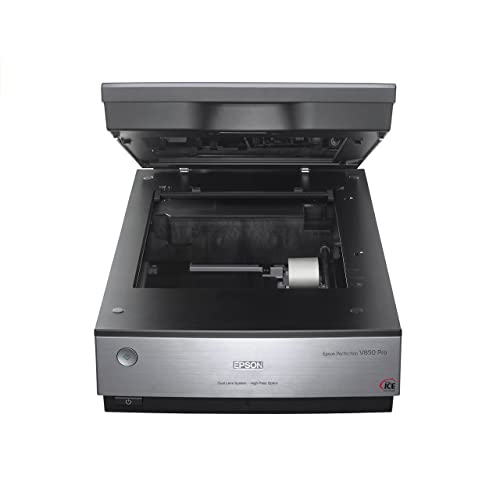
Professional Detail Pick – Epson Perfection V850 Pro
The Epson Perfection V850 Pro is a strong choice for photographers and archivists seeking photo scanners with digital ICE and high-resolution output. Its 6400 dpi resolution, 4.0 Dmax, CCD sensor, and dual-lens system are designed for detailed scans with smooth tonal transitions and fine shadow detail.
Best For: Professional-quality photo scanning, restoration work, and users who prioritize color and detail over compact size.
Pros:
- 6400 dpi resolution supports highly detailed scans.
- 4.0 Dmax helps preserve smooth gradations and shadow detail.
- Dual-lens system selects the appropriate lens for scanning results.
- Digital ICE supports photo restoration workflows.
Cons:
- Large and heavy at about 20.9 pounds.
- USB connectivity may be less convenient than wireless scanning.
- Its professional features may be more than casual users need.
The V850 Pro is best suited to demanding photo projects where scan quality and restoration capability matter most. Its size and wired setup make it less practical for occasional, space-conscious scanning.
Easy Batch Scanning Pick – Plustek ePhoto Z300
The Plustek ePhoto Z300 is a practical option for users who want photo scanners with digital ICE-style restoration support and a simple feed-through design. It scans common photo sizes at up to 600 dpi, with automatic cropping and deskewing to reduce cleanup after scanning.
Best For: Families and casual archivists digitizing large collections of standard-size photos on a Mac or PC.
Pros:
- Scans a 4×6 photo in about two seconds at 300 dpi.
- Supports 3×5, 4×6, 5×7, 8×10, letter, and A4 media.
- Automatic crop and deskew simplify the scanning process.
- Image enhancement tools can help restore faded photos.
Cons:
- Maximum optical resolution is 600 dpi.
- Photos must be inserted one at a time.
- Requires a USB-connected computer.
The Z300 favors speed and simplicity rather than professional-level resolution. It is a sensible fit for everyday photo digitization, especially when automatic corrections and straightforward computer software are more important than advanced controls.
High-Volume Family Archive Pick – Epson FastFoto FF-680W
The Epson FastFoto FF-680W is built for quickly digitizing large photo collections and includes automatic enhancement features associated with photo scanners with digital ICE. It can batch-scan up to 36 photos, scan at up to one photo per second at 300 dpi, and connect through USB or Wi-Fi.
Best For: Users scanning thousands of family photos, mixed-size prints, and documents who want wireless sharing and batch efficiency.
Pros:
- Batch-scans up to 36 photos at a time.
- Supports photos up to 8×10, panoramas, postcards, and Polaroid photos.
- Automatic enhancement includes color restoration, red-eye reduction, crop, and deskew.
- Duplex scanning captures handwritten notes on photo backs.
Cons:
- Its CIS sensor and listed 600 dpi resolution may not match a dedicated high-end flatbed for maximum detail.
- Automatic document feeding requires care with delicate or unusual photos.
- More expensive and specialized than a basic photo scanner.
The FF-680W is a productivity-focused choice for large archives. Its batch handling, wireless connectivity, and restoration tools make it especially useful when finishing a collection efficiently matters more than achieving the highest possible flatbed detail.
Standalone Film Conversion Pick – Magnasonic FS71 Film Scanner
The Magnasonic FS71 is a compact film and slide converter for users who want photo scanners with digital ICE-style convenience without relying on a computer. It converts several film formats into 24MP JPEG files, provides basic on-device color and brightness adjustments, and saves scans to an SD card.
Best For: Convenient home digitization of 35mm, 110, 126, Super 8 film, and compatible slides.
Pros:
- Supports multiple film and slide formats.
- Works without a computer or driver installation.
- Includes a 5-inch display and HDMI output for viewing.
- Saves images to SD cards up to 128GB.
Cons:
- Designed for film and slides rather than flat photo prints.
- SD card and HDMI cable are not included.
- Scanning is limited to the device’s built-in adjustments and JPEG workflow.
The FS71 is a convenient, self-contained option for converting film memories quickly. Choose it for broad format support and simple operation, but consider a dedicated flatbed when print-photo scanning or advanced restoration control is the priority.
High-Resolution Choice – Epson Perfection V800 Photo Scanner
The Epson Perfection V800 is a strong option among photo scanners with digital ICE for users who prioritize fine detail, tonal range, and flexible media scanning. Its 6400 dpi resolution, CCD sensor, 48-bit color depth, and dual-lens system are suited to careful photo, slide, and film digitization.
Best For: Photographers and archivists who want high-resolution scans with smooth gradations and detailed shadows.
Pros:
- 6400 dpi resolution and 48-bit color depth support detailed scans.
- 4.0 Dmax helps preserve tonal range and shadow detail.
- Dual Lens System selects between lenses for different scanning needs.
- Supports photos and slides with Windows and Mac compatibility.
Cons:
- At 20.9 pounds, it is relatively heavy and less portable.
- Its USB connection and computer-based workflow may be less convenient than a standalone scanner.
The V800 is best when scan quality matters more than speed or portability. It is a particularly capable fit for users building a detailed digital archive of prints and slides.
Fast Family Archiving – Canon imageFORMULA RS40 Photo Scanner
The Canon imageFORMULA RS40 is a practical pick among photo scanners with digital ICE for quickly processing mixed collections of photos and documents. Its automatic feeder scans both sides simultaneously and can handle varied media, including photos, Polaroids, receipts, cards, and IDs.
Best For: Families and home offices that need fast, batch scanning for photos and everyday documents.
Pros:
- Scans up to 40 items per minute through its automatic feeder.
- Handles photos and documents in varying sizes, including Polaroids and cards.
- Bundled software includes enhancement, red-eye correction, and digital face smoothing.
- Supports Windows and Mac with TWAIN drivers and multiple output formats.
Cons:
- Its listed color and grayscale depth are 8 bit, below the V800’s depth.
- The 60-sheet feeder and document-focused design may be less suited to delicate originals.
- Maximum listed resolution is 600 dpi, with 1200 dpi identified as interpolated.
The RS40 emphasizes convenience and throughput rather than maximum archival detail. Choose it when you have a large, varied stack to digitize and want built-in tools for quick photo cleanup.
Standalone Film Digitizer – DigitPro Photo, Slide & Negative Scanner
The DigitPro M129A offers a simple alternative among photo scanners with digital ICE for converting prints, slides, and negatives without a computer. It previews images on a large 5-inch screen and saves JPEG files directly to the included 8GB SD card.
Best For: Beginners and families who want an offline scanner for 35mm slides, 135 and 110 negatives, printed photos, and business cards.
Pros:
- Standalone operation requires no computer, apps, or drivers during scanning.
- 5-inch HD screen supports convenient previews and editing.
- Converts multiple film formats, printed photo sizes, and business cards.
- Includes an SD card, holders, trays, cleaning brush, and a 3-year warranty.
Cons:
- Its 1080P specification and CMOS sensor are less detailed than the V800’s listed resolution and CCD design.
- Images are saved as JPEGs, which may offer less flexibility for advanced archival workflows.
- The supplied notes identify HDMI and USB connectivity but do not specify a computer scanning software workflow.
The M129A is focused on ease of use and immediate results. It is a convenient choice for casual home digitization, especially when avoiding a computer during the scanning process is important.
Best High-Resolution Flatbed – Epson Perfection V600 Photo Scanner
The Epson Perfection V600 is a strong choice among photo scanners with digital ICE for users digitizing prints, slides, negatives, and medium-format film. Its 6400 x 9600 dpi resolution supports detailed scans and enlargements up to 17 x 22 inches, while the built-in Transparency Unit handles multiple film formats.
Best For: Photographers and families preserving mixed collections of prints, 35mm film, mounted slides, and medium-format negatives.
Pros:
- Digital ICE technology helps remove dust and scratches from scans.
- Scans 35mm slides, negatives, prints, and medium-format film.
- 6400 x 9600 dpi resolution supports large enlargements.
- ReadyScan LED technology requires no warm-up time.
Cons:
- Wired USB connectivity requires a computer connection.
- Its flatbed design takes more space than a compact film-only scanner.
The V600 is the most versatile option here for high-detail archival work, especially if you need both film and photo scanning. Its included restoration software and customizable buttons add convenience for recurring projects.
Best Computer-Free Option – KEDOK 22MP Photo and Film Scanner
The KEDOK is a convenient alternative among photo scanners with digital ICE, although the supplied specifications do not identify Digital ICE support. It converts supported photos, name cards, 35mm and 110 film, slides, and negatives directly to JPEG files, without requiring a computer.
Best For: Casual users who want a simple, standalone scanner with an LCD preview screen and included SD card.
Pros:
- Works without a computer and saves files directly to internal memory or an SD card.
- Large 5-inch LCD provides on-device previews.
- Supports 35mm and 110 film, slides, photos, and business cards.
- Includes an 8GB SD card and a three-year warranty.
Cons:
- The supplied notes do not mention Digital ICE dust and scratch removal.
- Its 24-bit color depth is lower than the Epson flatbed models listed here.
- It is designed for JPEG digitizing rather than high-resolution flatbed scanning.
The KEDOK prioritizes ease of use over advanced restoration. Its screen, card-based storage, and broad media support make it practical for quick family archiving, but users specifically seeking confirmed Digital ICE should consider an Epson model instead.
Best for Photo Restoration – Epson Perfection V550 Scanner
The Epson Perfection V550 is a practical pick among photo scanners with digital ICE for restoring and organizing older media. It combines 6400 dpi optical resolution with Digital ICE for film dust and scratch removal, Easy Photo Fix for faded images, and a built-in transparency unit for slides and negatives.
Best For: Users restoring faded family photographs while also scanning documents, slides, negatives, and multiple prints.
Pros:
- Digital ICE helps remove the appearance of dust and scratches on film.
- Easy Photo Fix supports one-touch faded-photo restoration.
- 6400 dpi optical resolution supports enlargements up to 17 x 22 inches.
- Auto edge detection can separate multiple photos into individual files.
Cons:
- Uses wired Hi-Speed USB 2.0 connectivity.
- The supplied notes list a one-year limited warranty.
The V550 is well suited to restoration-focused workflows, particularly when faded prints and dusty film need attention. Its document scanning and OCR software also make it more useful beyond photo preservation.
How We Picked the Best Photo Scanners with Digital Ice
We focused on scanners suited to photo preservation and restoration, giving priority to models that offer Digital ICE or comparable dust- and scratch-reduction capabilities where applicable. We also considered optical resolution, film support, scan speed, batch-handling features, software compatibility, connectivity, and ease of use.
The selection includes high-resolution flatbed scanners for serious archival work, automated photo feeders for large collections, and dedicated film digitizers for users whose priority is slides or negatives. Because no single scanner is ideal for every workflow, the comparison emphasizes practical strengths rather than one-size-fits-all rankings.
Quick Comparison
- Best for maximum detail: High-resolution Epson flatbeds with film holders and dual-lens systems.
- Best for large print collections: Automatic-feed models such as the Epson FastFoto and Canon imageFORMULA RS40.
- Best for simple 4-by-6 photo scanning: Compact photo-focused scanners with automatic cropping and straightening.
- Best for slides and negatives: Dedicated film scanners with built-in displays and support for multiple film formats.
- Best for flexible home archiving: Flatbed models that scan photos, documents, film, and negatives in one device.
Key Buying Factors for Photo Scanners with Digital Ice
Resolution and Real-World Detail
Do not choose based only on the highest advertised dpi. Optical resolution matters more than interpolated resolution, especially when enlarging small prints or scanning 35mm film. A 4-by-6 photo generally needs less resolution for sharing, while negatives and slides benefit from higher optical performance.
Media Compatibility
Check whether the scanner supports your actual collection. Flatbeds are versatile for prints, documents, books, and some film holders. Dedicated film scanners may support 35mm, 110, 126, Super 8, or other formats, but they may not handle standard photo prints well.
Digital ICE and Software Controls
Digital ICE can reduce visible dust and scratches during scanning, but it may increase scan times and is not equally useful for every medium. Look for adjustable color restoration, fading correction, batch scanning, cropping, and dust-removal controls when working with mixed-condition originals.
Speed and Workflow
For hundreds or thousands of prints, an automatic document feeder or photo feeder can save substantial time. Flatbed scanners are slower but usually provide more flexibility and better control over delicate, unusual, or oversized originals.
File Formats and Connectivity
Confirm support for your computer and operating system before buying. For preservation, save master scans in a lossless format such as TIFF when practical, then create smaller JPEG copies for sharing. USB remains common, while wireless models can simplify household workflows.
Who Should Buy Which Photo Scanners with Digital Ice?
Choose a high-resolution flatbed if you want the best control for enlargements, fragile prints, artwork, slides, and negatives. These models are especially suitable for archival projects where image quality matters more than speed.
Choose a fast photo feeder if you have boxes of similarly sized prints and want to digitize them efficiently. Automatic cropping, straightening, and batch processing can make a major difference for large collections.
Choose a dedicated film scanner if your archive is mostly slides or negatives. A built-in screen and support for several film formats can make quick, standalone conversion convenient, though these devices may offer less flexibility for printed photos.
Choose an all-purpose scanner if you need one machine for occasional photos, documents, and film. It may not be the fastest or most specialized option, but it offers the broadest everyday usefulness.