The right scanner can help a small business digitize customer photos, receipts, records, and marketing materials without adding unnecessary complexity. The best choice depends on your workload, image-quality needs, available space, and preferred workflow.
We’ve compared 10 photo and document scanners across speed, connectivity, scanning features, portability, and ease of use to help you choose a practical fit for your office.
Best 10 Photo Scanners for Small Businesses Picks for 2026
High-Volume Photo Workhorse

- Scans up to 36 photos per batch
- Duplex capture preserves notes on photo backs
- Wi-Fi, OCR, and restoration tools
Best For: Large photo archives and mixed photo-document workflows
Simple Flatbed Value

- 2400 x 2400 dpi optical resolution
- Auto Scan Mode simplifies setup
- Handles photos, receipts, cards, and documents
Best For: Individual scans and occasional office digitization
Dedicated Photo Feeder

- Scans 4 x 6 photos in about two seconds
- Supports photos from 3 x 5 to 8 x 10
- Auto-crop, deskew, and enhancement tools
Best For: Standard-size photo digitization on Mac or PC
Compact Office All-Rounder

- Compact design for small workspaces
- Up to 30 ppm duplex scanning
- Wi-Fi and USB with broad media support
Best For: Mixed photo, document, receipt, and card scanning
Best Flatbed Value

- 4800 dpi optical resolution for detailed photo scans
- Easy Photo Fix restores faded photo color
- Compact, USB-powered flatbed design
Best For: Photos, artwork, books, and occasional office documents
Best High-Volume Workflow

- 45 ppm duplex scanning with a 100-sheet feeder
- Wi-Fi 6, USB-C, touchscreen, and cloud support
- Organizes documents, receipts, photos, and cards
Best For: Busy offices with recurring batch-scanning needs
Best Portable Option

- Ultra-light 9.44-ounce mobile design
- Scans a single page in as quickly as 5.5 seconds
- OCR and cloud scanning support included
Best For: Traveling staff, receipts, IDs, and occasional documents
Best with Extra Features
HPPS100 Mobile Document & Photo Scanner

- 15 ppm simplex scanning
- 1200 dpi resolution
- USB-powered, 3-ounce design
Best For: Mobile professionals and small offices with light-to-medium scanning needs
Best for Photo Detail

- 4800 x 4800 dpi resolution
- Photo color restoration and dust removal
- USB Type-C power and data
Best For: Businesses prioritizing detailed photo and image scanning
Best Duplex Workflow
Canon imageFORMULA R10 Portable Scanner
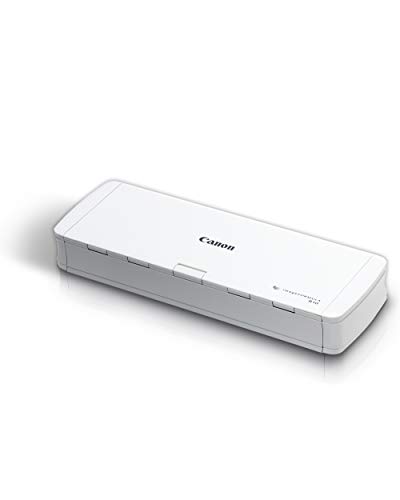
- Duplex scanning at up to 12 ppm
- 20-sheet automatic document feeder
- Built-in Windows and Mac software
Best For: Mobile offices processing two-sided business documents
High-Volume Photo Workhorse – Epson FastFoto FF-680W
For small businesses digitizing large photo collections, the Epson FastFoto FF-680W combines rapid batch scanning with wireless connectivity and image-restoration tools. It can scan up to 36 photos at a time, capture a photo at 300 dpi in about one second, and handle mixed photo sizes up to 8 x 10 inches.
Best For: Small businesses processing large archives of family photos, customer images, postcards, and related documents.
Pros:
- High-speed scanning with batch capacity for up to 36 photos
- Duplex scanning captures handwritten notes on photo backs in one pass
- Auto enhancement, color restoration, red-eye reduction, cropping, rotation, and de-skew
- Wi-Fi, USB, OCR, and direct backup options for Dropbox and Google Drive
Cons:
- Larger and heavier than basic flatbed models
- Its strongest advantages are geared toward high-volume photo workflows
The FF-680W is a particularly capable choice among photo scanners for small businesses when speed, batch handling, and preservation features matter more than a compact footprint.
Simple Flatbed Value – Canon CanoScan LiDE 300
The Canon CanoScan LiDE 300 is a straightforward USB flatbed option for small businesses that need to digitize individual photos, receipts, business cards, and documents. Its 2400 x 2400 dpi optical resolution and Auto Scan Mode make occasional scanning easy without a complicated setup.
Best For: Small offices needing an affordable, compact scanner for individual documents and images.
Pros:
- High 2400 x 2400 dpi optical resolution
- Auto Scan Mode detects the type of item being scanned
- Supports photos, receipts, business cards, and paper documents
- Lightweight 3.6-pound design with USB connectivity
Cons:
- USB connectivity only
- Single-item standard sheet capacity is less suited to batch work
For businesses scanning a modest number of items at a time, the LiDE 300 is a practical entry-level pick among photo scanners for small businesses, especially when detailed flatbed scans are more important than speed.
Dedicated Photo Feeder – Plustek ePhoto Z300
The Plustek ePhoto Z300 offers a focused workflow for small businesses converting stacks of common photo sizes. It scans a 4 x 6 photo in about two seconds at 300 dpi, supports 3 x 5 through 8 x 10 photos plus letter and A4 paper, and includes auto-crop, deskew, and image-enhancement functions.
Best For: Businesses digitizing many standard-size photos while keeping the process simpler than using a flatbed scanner.
Pros:
- Fast feed-through scanning for 4 x 6 photos
- Supports multiple photo sizes along with letter and A4 paper
- Auto-crop and deskew streamline image processing
- Works with both Windows and Mac systems
Cons:
- USB connection rather than wireless connectivity
- Photos must be inserted one at a time
- Maximum optical resolution is 600 dpi
The ePhoto Z300 is a sensible middle ground among photo scanners for small businesses: faster and more photo-oriented than a conventional flatbed, but less feature-rich for broader office automation than a document-focused model.
Compact Office All-Rounder – ScanSnap iX1300
The ScanSnap iX1300 is a space-saving choice for small businesses that need one scanner for photos, documents, receipts, cards, and other everyday media. Its Wi-Fi or USB connectivity, up to 30 pages-per-minute duplex scanning, and automatic image adjustments support efficient office workflows in a compact footprint.
Best For: Small offices that need a versatile scanner for mixed documents and occasional photo work.
Pros:
- Compact design fits easily in limited desk space
- Up to 30 ppm duplex scanning with automatic de-skew and blank-page removal
- Supports USB, Wi-Fi, mobile devices, cloud services, and Chromebook scanning
- Handles documents, photos, receipts, business cards, and plastic cards
Cons:
- Photo scanning is one part of a broader document-focused design
- Compatibility requirements vary by operating system and device
The iX1300 stands out among photo scanners for small businesses that prioritize versatility and workspace efficiency. It is a strong fit when photo digitization needs to share space with routine document and receipt scanning.
Best Flatbed Value – Epson Perfection V19 II
For small businesses that need photo scanners for small businesses with strong image detail, the Epson Perfection V19 II is a compact flatbed option. Its 4800 dpi optical resolution suits photo enlargements, artwork, books, and everyday documents.
Best For: Small offices and creative businesses scanning photos, artwork, books, and documents.
Pros:
- 4800 dpi optical resolution delivers detailed scans for photo enlargements.
- Easy Photo Fix can restore color to faded photos with one click.
- ScanSmart software supports searchable PDFs and editable Office files through OCR.
- USB-powered, lightweight design includes a kickstand for vertical storage.
Cons:
- Flatbed design requires placing items individually rather than feeding a stack.
- USB connectivity does not provide wireless scanning.
The V19 II is a practical choice when image quality and flexible flatbed scanning matter more than high-volume document throughput. It also scans letter-size documents in as fast as 10 seconds.
Best High-Volume Workflow – ScanSnap iX2500
Businesses comparing photo scanners for small businesses may prefer the ScanSnap iX2500 when scanning speed and workflow automation are priorities. It combines 45-page-per-minute duplex scanning, a 100-sheet feeder, wireless connectivity, and touchscreen controls.
Best For: Busy small offices organizing documents, receipts, photos, and business cards in volume.
Pros:
- Scans up to 45 pages per minute with double-sided capture.
- 100-sheet automatic document feeder supports larger scan jobs.
- Wi-Fi 6 and USB-C enable flexible computer, mobile, and cloud connections.
- Automatic optimization, naming, sorting, and feed-protection features streamline workflows.
Cons:
- At 7.7 pounds, it is less portable than compact single-sheet scanners.
- Its 600 dpi resolution is lower than the flatbed Epson’s stated optical resolution for detailed enlargements.
The iX2500 is the strongest fit for teams that need an organized, shareable scanning hub rather than a primarily photo-focused flatbed. Its touchscreen profiles and cloud support can reduce repetitive handling.
Best Portable Option – Epson WorkForce ES-50
For mobile professionals seeking photo scanners for small businesses, the Epson WorkForce ES-50 offers a lightweight single-sheet design. It is USB-powered, scans a page in as quickly as 5.5 seconds, and handles receipts, ID cards, and documents up to 8.5 by 72 inches.
Best For: Traveling staff and small businesses scanning receipts, forms, IDs, and occasional photos at a desk or on the road.
Pros:
- Weighs 9.44 ounces and is designed for on-the-go use.
- USB power eliminates batteries and an external power supply.
- OCR creates searchable PDFs and editable Word and Excel files.
- Automatic feeding mode combines multiple inserted sheets into one file.
Cons:
- Single-sheet feeding is less suitable for large document batches.
- USB-only connectivity does not offer wireless scanning.
- Its 1200 dpi resolution is more modest than the V19 II’s 4800 dpi specification.
The ES-50 makes sense when portability and straightforward document capture outweigh flatbed photo flexibility or batch speed. Its compact USB-powered setup is especially useful for field work and shared desks.
Best with Extra Features – HPPS100 Mobile Document & Photo Scanner
For small businesses that need photo scanners for small businesses without a bulky setup, the HPPS100 is a lightweight, USB-powered option. It scans one side at up to 15 pages per minute and supports photos, receipts, business cards, and documents on Windows and Mac.
Best For: Mobile professionals, tax preparers, legal practices, and small offices handling light-to-medium batches.
Pros:
- Compact 3-ounce design is easy to carry in a bag or briefcase.
- 15-page-per-minute simplex scanning supports color and black-and-white jobs.
- 1200 dpi resolution and support for PDF, JPG, and other file formats.
- HP WorkScan software includes auto-scan, size detection, cropping, and image cleanup tools.
Cons:
- Scans one side at a time rather than duplex.
- USB-powered operation requires a connected computer and cable.
- Its 10-sheet capacity is better suited to small batches than high-volume work.
The HPPS100 is a practical choice when portability and straightforward simplex scanning matter more than automated document feeding. Its compact footprint and included software make it especially useful for traveling or space-constrained businesses.
Best for Photo Detail – Canon CanoScan LiDE 400
Canon CanoScan LiDE 400 Slim Scanner, 7.7" x 14.5" x 0.4", Document & Photo Scanner, Black
Check Price On AmazonThe Canon CanoScan LiDE 400 is a flatbed option for small businesses that prioritize detailed photo and document scans. Its 4800 x 4800 dpi resolution, color restoration, and dust-removal features are designed for preserving image quality, while USB Type-C handles both power and data.
Best For: Studios, offices, and creative businesses digitizing photos, letter-size documents, and image-heavy materials.
Pros:
- 4800 x 4800 dpi resolution captures detailed photos and images.
- Color restoration and dust removal can improve older photo scans.
- Auto Scan mode detects the material being scanned.
- Built-in PDF buttons support multi-page, editable, and searchable PDFs.
Cons:
- Flatbed design scans one item at a time.
- At 3.6 pounds, it is less portable than compact sheetfed models.
- USB-connected operation may be less convenient for mobile scanning.
The LiDE 400 is the stronger fit when image fidelity is the priority. Its flatbed workflow is slower for stacks of paperwork, but the high resolution and photo-oriented enhancements make it compelling for businesses preserving visual materials.
Best Duplex Workflow – Canon imageFORMULA R10 Portable Scanner
The Canon imageFORMULA R10 is a portable document feeder scanner for small businesses that need efficient paperwork processing. It scans both sides simultaneously at up to 12 pages per minute, uses a 20-sheet automatic feeder, and supports Windows and Mac without requiring separate software installation.
Best For: Mobile offices and small businesses scanning receipts, reports, cards, and other two-sided documents.
Pros:
- Duplex scanning captures both sides in a single pass.
- 20-sheet automatic feeder supports more efficient batch work.
- Handles receipts, business cards, plastic or embossed cards, and legal documents.
- Built-in software supports searchable PDFs, JPEGs, editing, and custom destinations.
Cons:
- It is not intended for scanning photographs on photo paper or photographic media.
- 12 pages per minute is slower than the HPPS100’s stated simplex speed.
- USB-powered operation limits use to locations with a compatible computer connection.
The R10 is the best workflow choice here for businesses handling two-sided paperwork rather than photo media. Its feeder, duplex capability, and built-in software reduce manual handling for routine document digitization.
How We Picked the Best Photo Scanners for Small Businesses
We focused on scanners that balance useful photo quality with the document-handling features small businesses need every day. Our comparison considered scanning speed, duplex capability, automatic document feeders, optical resolution, connectivity, software support, size, and portability. We also included a range of designs, from dedicated photo scanners and flatbeds to compact sheetfed models.
Because business workloads vary, no single scanner is ideal for everyone. A photo-heavy archive project calls for different hardware than a mobile professional scanning invoices or contracts.
Quick Comparison
- Best for large photo batches: Epson FastFoto FF-680W
- Best for compact flatbed scanning: Epson Perfection V19 II
- Best for simple occasional scans: Canon CanoScan LiDE 300
- Best for wireless desktop scanning: ScanSnap iX1300 or iX2500
- Best for portable document work: Epson WorkForce ES-50 or Canon imageFORMULA R10
- Best for rapid 4-by-6-inch photo scanning: Plustek ePhoto Z300
Key Buying Factors for Photo Scanners for Small Businesses
Photo Quality and Resolution
Optical resolution matters more than an inflated software-enhanced number. For everyday prints, receipts, and records, a 600-dpi-class scanner is often sufficient. Choose a higher-resolution flatbed or dedicated photo model when you plan to enlarge images, preserve fine detail, or scan negatives and delicate originals.
Feeder Versus Flatbed Design
Automatic document feeders are more efficient for stacks of pages, while flatbeds are safer for photographs, books, certificates, and fragile originals. Some models combine both approaches, but compact sheetfed scanners generally prioritize speed and portability over versatility.
Duplex Scanning and Workflow Speed
Duplex scanning captures both sides of a page in one pass and can save substantial time when processing contracts, forms, or bookkeeping records. For occasional scanning, a manual-feed model may be adequate; for recurring office work, look for an ADF and fast multi-page handling.
Connectivity and Software
USB is dependable and widely compatible. Wi-Fi is more convenient for shared offices and scanning directly to computers or mobile devices, but it can require additional setup. Check operating-system compatibility and confirm that included software supports searchable PDFs, automatic cropping, deskewing, and cloud destinations if those features matter to your workflow.
Size, Maintenance, and Total Cost
Measure your available desk space and consider whether the scanner can be stored between uses. Also account for replacement rollers, cleaning, power requirements, and the time employees spend correcting skewed pages or organizing files. A slightly more expensive model may be worthwhile if it reduces manual work.
Who Should Buy Which Photo Scanners for Small Businesses?
Choose the Epson FastFoto FF-680W or Plustek ePhoto Z300 if your main priority is digitizing collections of printed photographs quickly. Pick a flatbed such as the Epson Perfection V19 II or a Canon LiDE model for careful handling of individual photos, artwork, books, and mixed-size originals.
For shared office document workflows, the ScanSnap iX1300 and iX2500 offer convenient desktop scanning, while the Canon imageFORMULA R10 and Epson WorkForce ES-50 suit users who need a portable USB-powered setup. The HP portable scanner is a practical choice for straightforward single-sided scanning when space and simplicity are more important than high-volume automation.
Before buying, estimate your weekly page volume, identify the originals you scan most often, and decide whether wireless access or portability will save meaningful time. Those answers will narrow the list more effectively than resolution or speed specifications alone.