Digitizing negatives and slides is easier when your scanner can reduce dust, static, and surface debris before they become part of every scanned image. The right model can also save time with larger previews, broad format support, and straightforward file export.
This roundup compares 10 options for casual family archives, batch scanning, and high-detail 35mm work. Use the buying guide below to match scanning quality, cleaning features, software, and workflow to your collection.
Best 10 Film Scanners with Dust Removal Picks for 2026
Easy Home Digitizing
KODAK Slide N Scan Film Scanner

- Scans 135, 110, and 126 negatives plus 50mm slides
- 5-inch LCD enables previews and gallery viewing
- Includes cleaning brush and film adapters
Best For: Home users digitizing varied film formats
Pre-Scan Dust Control

- Neutralizes static with a built-in ionizer
- Soft wool brush helps remove dust and lint
- Fits 35mm, 120 film, and mounted slides
Best For: Pre-cleaning film before scanning
Simple Standalone Scanning
ClearClick Virtuoso 2.0 Film Scanner
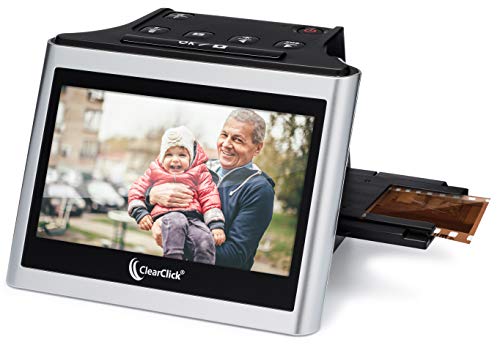
- Scans 35mm, 110, and 126 film plus 50mm slides
- 5-inch screen provides real-time previews
- Requires no computer or drivers
Best For: Convenient computer-free home scanning
Professional Infrared Correction
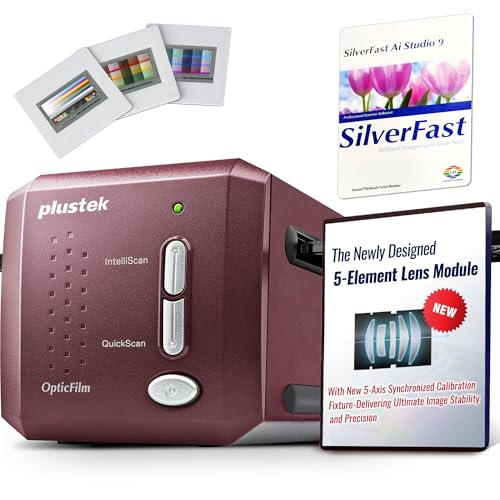
- Infrared SilverFast iSRD removes dust and scratches
- 7200 dpi optical resolution captures fine detail
- Includes IT8 calibration and professional software
Best For: High-quality 35mm restoration and archiving
Best All-in-One Option
DigitPro 5-Inch Photo, Slide & Negative Scanner

- Scans film, slides, photos, and business cards
- 5-inch screen with standalone one-touch operation
- Includes 8GB SD card and 3-year warranty
Best For: Families and beginners digitizing mixed media without a computer
Best Large-Screen Workflow

- Quick-feeding tray supports continuous scanning
- Handles 135mm, 110mm, and 126mm film
- 7-inch LCD and direct SD-card saving
Best For: Home archivists scanning mixed film collections
Best for Dust and Scratch Correction

- Digital ICE removes the appearance of dust and scratches
- 6400 dpi optical resolution for detailed enlargements
- Scans film, photos, documents, and multiple photos at once
Best For: Restoring 35mm film and photos with a computer-based workflow
Easy Home Digitizer

- Scans 35mm, 110, and 126 film
- Large 7-inch LCD preview
- Works without a computer
Best For: Simple home digitizing across multiple film formats
High-Resolution Choice

- 7200 DPI 35mm scanning
- CCD sensor with 48-bit output
- SilverFast software included
Best For: Detailed computer-based 35mm scanning
Dust-Removal Specialist

- Infrared dust and scratch removal
- 7200 DPI scanning
- SilverFast and QuickScan included
Best For: 35mm archival scanning with automated correction
Easy Home Digitizing – KODAK Slide N Scan Film Scanner
The KODAK Slide N Scan is a convenient choice for shoppers seeking film scanners with dust removal support through an included cleaning brush and straightforward home scanning features. It handles 135, 110, and 126 negatives plus 50mm slides, and saves converted files to an SD or SDHC card.
Best For: Families and hobbyists digitizing mixed-format negatives and slides without a complicated computer-based workflow.
Pros:
- Supports 135, 110, and 126 film formats and 50mm slides.
- Large 5-inch LCD screen provides instant previews and gallery viewing.
- Includes a cleaning brush, film adapters, USB cable, and HDMI cable.
- Offers simple color, brightness, resizing, and date/time adjustments.
Cons:
- SD or SDHC card is required but not included.
- The listed 22MP resolution is based on the product specification and may not represent optical resolution.
- Minimum listed computer requirement is Windows 7.
Its broad format support, built-in display, and included brush make it practical for casual archival projects. Choose it when convenience matters more than professional infrared dust and scratch correction.
Pre-Scan Dust Control – Anti-Static Film Dust Remover
This anti-static negative cleaner is designed to complement film scanners with dust removal workflows by treating the film before it reaches the scanner. Its ionizer helps neutralize static, while the soft wool brush lifts dust, lint, and particles from compatible film surfaces.
Best For: Film photographers who want to reduce loose dust before scanning 35mm negatives, 120 film, or mounted slides.
Pros:
- Ionizer is designed to reduce static that attracts airborne dust.
- Soft wool brush is intended for delicate film emulsions.
- Accommodates standard 135 strips, 120 medium-format film, and mounted slides.
- USB-C power supports plug-and-play desktop use.
Cons:
- It is a film-cleaning accessory, not a scanner or digital capture device.
- A subtle hissing sound may occur during ionization.
- Its effectiveness depends on physically brushing the film before scanning.
For dusty archives, this tool can help shift cleaning earlier in the workflow and potentially reduce later spot removal. It is best paired with a scanner rather than used as a standalone digitizing solution.
Simple Standalone Scanning – ClearClick Virtuoso 2.0 Film Scanner
The ClearClick Virtuoso 2.0 suits shoppers comparing film scanners with dust removal accessories or pre-cleaning routines, though the supplied notes do not specify built-in infrared dust correction. It scans 35mm, 110, and 126 negatives plus 50mm slides and shows results on an extra-large LCD screen.
Best For: Users who want a simple, computer-free way to preview and digitize common consumer film formats.
Pros:
- Supports 35mm, 110, and 126 negatives and 50mm slides.
- Extra-large 5-inch preview screen shows images as you scan.
- Works without a computer or drivers.
- Includes a two-year warranty with optional extension through registration.
Cons:
- SD card is not included.
- 22MP resolution is identified as interpolated.
- Mini HDMI cable is not included.
This model emphasizes ease of use and standalone operation rather than advanced restoration features. Pairing it with careful manual film cleaning can make it a practical choice for straightforward home digitization.
Professional Infrared Correction – Plustek OpticFilm 9000i Ai
The Plustek OpticFilm 9000i Ai is the strongest match here for film scanners with dust removal because it combines an infrared channel with SilverFast iSRD technology to automatically address dust and scratches. Its 7200 dpi optical resolution, 48-bit color depth, and calibration tools target demanding 35mm digitization work.
Best For: Photographers, studios, and serious film enthusiasts seeking high-detail 35mm scans with automated dust and scratch correction.
Pros:
- Infrared dust and scratch removal works with SilverFast iSRD.
- True optical resolution reaches 7200 dpi with 48-bit color depth.
- Five-axis alignment supports consistent focus and stability.
- Includes SilverFast Ai Studio, QuickScan Plus, and an IT8 calibration target.
Cons:
- Designed for 35mm negatives and slides rather than multiple consumer film formats.
- Professional software and calibration features may be excessive for casual scanning.
- Requires a compatible Windows or macOS computer and uses USB connectivity.
Among these options, this is the most capable choice for restoration-oriented scanning and high-resolution archival output. Its higher-end workflow is best justified when image detail, color accuracy, and reduced retouching time matter.
Best All-in-One Option – DigitPro 5-Inch Photo, Slide & Negative Scanner
The DigitPro M129A is a practical choice among film scanners with dust removal for users who want an offline, all-in-one digitizing setup. It handles 35mm, 135 and 110 negatives, slides, printed photos, and business cards, with scans saved directly to the included 8GB SD card.
Best For: Families and beginners digitizing mixed media without a computer.
Pros:
- Supports slides, 35mm, 135 and 110 negatives, photos, and business cards.
- Large 5-inch HD screen for previewing and editing.
- Standalone operation with one-touch controls and SD-card storage.
- Includes holders, trays, cleaning brush, SD card, and a 3-year warranty.
Cons:
- Its listed 1080P resolution is lower than the Epson’s 6400 dpi specification.
- Supplied notes do not specifically mention automated dust or scratch removal.
This is a convenient, gift-friendly scanner when simplicity and broad media support matter most. The large display and included accessories make it easy to start, though buyers prioritizing dedicated dust and scratch correction may prefer the Epson.
Best Large-Screen Workflow – KODAK Slide N Scan Max
The KODAK Slide N Scan Max is a strong option among film scanners with dust removal for users who want a straightforward way to process mixed film formats. Its quick-feeding tray, direct SD-card saving, and 7-inch tiltable LCD are designed to keep home scanning simple and efficient.
Best For: Home archivists scanning 135mm, 110mm, and 126mm film collections.
Pros:
- Quick-feeding tray supports continuous scanning without repositioning each frame.
- Handles 135mm, 110mm, and 126mm film.
- Saves directly to SD or SDHC cards up to 32GB without a computer.
- 7-inch tiltable LCD doubles as a digital picture frame.
Cons:
- Supplied notes do not specifically list dust or scratch removal.
- Its one-year limited warranty is shorter than the DigitPro’s listed warranty.
- The minimum system requirement lists Windows 7, which may matter for computer-based workflows.
The Max emphasizes convenience rather than advanced restoration: it is well suited to larger batches and varied film formats. Choose it for the large display and quick-feeding design, but verify that its editing features meet your dust-removal expectations.
Best for Dust and Scratch Correction – Epson Perfection V550
The Epson Perfection V550 stands out among film scanners with dust removal because its Digital ICE technology is specifically designed to remove the appearance of dust and scratches on film. It also combines 6400 dpi optical resolution, a built-in transparency unit, and photo restoration tools for more detailed computer-based work.
Best For: Users restoring 35mm film and photos who want high resolution and dedicated correction tools.
Pros:
- Digital ICE technology removes the appearance of dust and scratches on film.
- 6400 dpi optical resolution supports enlargements up to 17 by 22 inches.
- Scans 35mm slides, negatives, photos, and documents.
- 48-bit color depth, OCR software, and multi-photo scanning add versatility.
Cons:
- Requires a computer connection rather than standalone SD-card operation.
- At 9.6 pounds, it is substantially heavier than the listed portable scanners.
- Supplied system requirements list Windows 7 and a one-year limited warranty.
The V550 is the clearest fit when dust and scratch correction is the deciding factor. Its high resolution and restoration features suit careful archival work, although its larger computer-dependent design is less convenient for quick, standalone scanning.
Easy Home Digitizer – ClearClick Virtuoso 3.0
The ClearClick Virtuoso 3.0 is a convenient choice for shoppers seeking film scanners with dust removal, although the supplied specifications do not list a dedicated dust- or scratch-removal feature. It scans 35mm, 110, and 126 negatives plus 50mm slides directly to an SD card, without a computer or drivers.
Best For: Casual home users who want a simple, computer-free way to digitize several film formats.
Pros:
- Supports 35mm, 110, and 126 negatives and 50mm slides.
- Offers 14MP scanning or 22MP interpolated output.
- Large 7-inch LCD preview screen makes framing convenient.
- Includes a two-year warranty, extendable to three years with registration.
Cons:
- SD card is required and not included; capacity is limited to 32GB or less.
- Mini HDMI cable is not included.
- No dedicated dust-removal capability is specified.
Choose this model for ease of use and broad format support rather than specialized restoration. Its standalone workflow is particularly practical for occasional family-archive projects.
High-Resolution Choice – Plustek OpticFilm 8100
The Plustek OpticFilm 8100 is a computer-connected option for shoppers comparing film scanners with dust removal. Its supplied notes emphasize 7200 DPI resolution, a CCD sensor, 48-bit output, and bundled SilverFast SE Plus software, but do not specifically confirm infrared dust or scratch removal.
Best For: 35mm users who prioritize high-resolution files, shadow detail, and software-based control.
Pros:
- Scans 35mm negatives and slides at up to 7200 DPI.
- CCD sensor and 48-bit output support detailed image capture.
- Includes SilverFast SE Plus and Plustek QuickScan software.
- Supports Windows and Mac operating systems listed in the notes.
Cons:
- Designed for 35mm media rather than multiple film formats.
- Requires a computer and USB connection.
- Dedicated dust-removal functionality is not specified.
The OpticFilm 8100 is better suited to deliberate, high-detail scanning than quick standalone conversion. Its software bundle adds control, but buyers specifically seeking automated dust removal should verify the included feature set before purchasing.
Dust-Removal Specialist – Plustek OpticFilm 8300i SE
The Plustek OpticFilm 8300i SE is the strongest match here for shoppers seeking film scanners with dust removal. It uses a built-in infrared channel with SilverFast iSRD software to detect and remove dust or scratches, while also offering 7200 DPI scanning and multi-exposure support.
Best For: 35mm film archivists who want automated dust and scratch correction alongside high-resolution scans.
Pros:
- Built-in infrared channel works with SilverFast iSRD for dust and scratch removal.
- Scans up to 7200 x 7200 DPI, listed as 69MP resolution.
- Multi-exposure function supports shadow and highlight detail.
- Includes SilverFast SE Plus 9 and Plustek QuickScan Plus.
Cons:
- Supports 35mm negatives and slides rather than multiple film sizes.
- Requires a computer and USB connection.
- Software and operating-system compatibility should be checked before purchase.
For restoration-oriented 35mm work, the 8300i SE offers the most directly stated dust-removal capability in this group. Its advanced software and high resolution make it a stronger fit for careful archiving than casual, computer-free scanning.
How We Picked These Film Scanners with Dust Removal
We selected products across several scanning styles, from compact one-touch units for 35mm, 110, and 126 film to dedicated film scanners designed for higher optical detail. We considered resolution claims, supported formats, preview screens, bundled software, scanning speed, dust-control features, and the level of manual work required.
Dust removal can mean different things. Some scanners use infrared hardware and software to detect dust and scratches, while others rely on anti-static cleaning accessories, ionizers, or careful manual preparation. Those approaches are not interchangeable, so buyers should check exactly what the product includes before ordering.
Quick Comparison
- Best for simple home transfers: Standalone 22MP scanners with built-in screens and direct memory-card or USB workflows.
- Best for detailed 35mm scans: Dedicated Plustek models with higher optical resolution and bundled SilverFast software.
- Best for mixed media: Flatbed scanners such as the Epson Perfection V550, which can handle film, photos, and documents.
- Best for reducing handling dust: An anti-static cleaner or ionizer used before scanning, especially with older negatives and slides.
Key Buying Factors for Film Scanners with Dust Removal
Dust and Scratch Correction
Look for infrared dust and scratch removal when preserving valuable 35mm film, but verify software and operating-system compatibility. A brush or ionizer can reduce loose particles, yet it usually will not restore scratches already embedded in the emulsion.
Resolution and Real-World Detail
High advertised DPI does not always equal high resolved detail. Dedicated film scanners generally provide more consistent results than inexpensive camera-style converters, while flatbeds offer greater versatility. For family sharing, 10MP-to-22MP output may be sufficient; extensive cropping and printing benefit from better optical performance.
Film Formats and Workflow
Confirm whether you need 35mm only or also 110 and 126 film. A large LCD can make fast, standalone scanning convenient, while computer-based scanners often provide stronger color controls, batch tools, and restoration software.
Color, Software, and File Output
Check whether the scanner supports TIFF as well as JPEG, includes calibration or color-management tools, and works with your computer. Bundled SilverFast versions can add useful correction features, but they may require a steeper learning curve.
Who Should Buy Which Film Scanners with Dust Removal?
Choose a compact KODAK or ClearClick scanner if convenience, built-in viewing, and quick family archiving matter most. Choose a Plustek OpticFilm model if you primarily scan 35mm and want more control, sharper detail, or restoration-oriented software. The Epson flatbed is the better fit for households that also scan prints, documents, and other transparent media. Add an anti-static cleaner when your collection attracts dust or when you want a cleaner preparation routine before using any scanner.