The right dress form can make fitting, draping, and pattern adjustments far more predictable. These adjustable dress forms cover petite, small, medium, and larger size ranges for home sewists, designers, and clothing displays.
Below, compare the key differences in adjustment range, shape, stability, and included features before choosing a form that matches your measurements and projects.
Best 10 Adjustable Dress Forms Picks for 2026
Best Overall Adjustability
Dritz Sew You Adjustable Dress Form

- 12 multi-point body adjustments
- Height adjusts up to 62.5 inches
- Includes a 360-degree hem marker
Best For: Small-to-medium garment sewing and detailed fitting
Best Mobile Display Option
Beige Adjustable Dress Form Mannequin

- 13 soft-grip adjustment dials
- Detachable, lockable casters
- Cotton-covered pinnable body
Best For: Mobile sewing, clothing display, and shop use
Best for Tailoring Accuracy
Dritz My Double Designer Dress Form

- 12 measurement-marked adjustment wheels
- Adds up to 2 inches of torso length
- Offset pole supports pants fitting
Best For: Detailed tailoring, jackets, gowns, and pants
Best for Larger Size Ranges

- Fits approximately US sizes 10–18
- 12 adjustable fitting dials
- Foam-backed flannel surface
Best For: Larger-size dressmaking and garment alterations
Petite Precision Pick
Dritz Twin-Fit Adjustable Dress Form

- 13 multi-point adjustments for detailed fitting
- Petite US 00–4 size range
- 360-degree hem marker and pinnable surface
Best For: Petite sewists focused on precise garment fitting
Versatile Sewing Standout

- 12 thumb wheels adjust key body measurements
- Fits approximate US sizes 4–12
- Includes calibrated pole and Pin Grip Hem Marker
Best For: Home sewists needing broad size and height adjustment
Accessible All-Rounder

- 12 dials for neck, bust, waist, and hip fitting
- Foam-backed flannel supports easy pinning
- Tool-free height adjustment and 360-degree hem guide
Best For: Everyday sewing and alterations in US sizes 4–10
Best for Plus-Size Adjustability
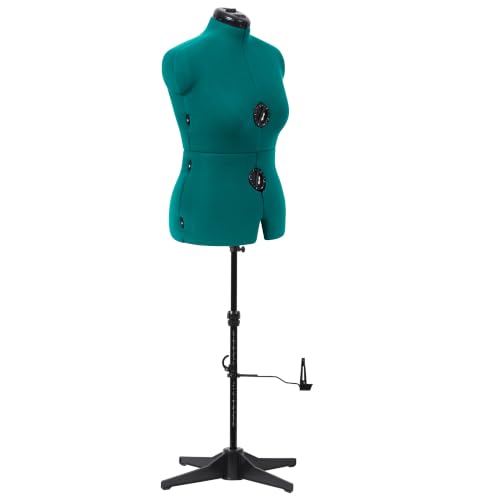
- 12 adjustment areas for sizes 12–18
- Height adjustment up to 63 inches
- Foam-backed surface and 360° hem marker
Best For: Sewists fitting garments in approximate US women's sizes 12–18
Best Lightweight Value
Adjustable Small/Medium Manikin
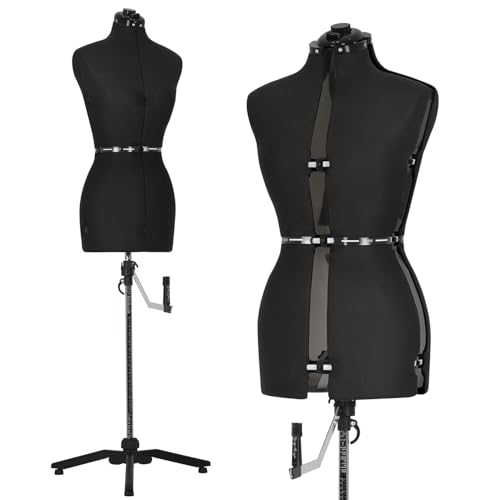
- 12 adjusters for key body measurements
- Height range of 38.6–63.2 inches
- Lightweight 7-pound construction
Best For: Beginners needing a movable form for fitting, display, or décor
Best for Small-Size Sewing

- 13 multi-point adjustments for sizes 4–10
- Torso length extends up to 2 inches
- Foam-backed surface and 360° hem marker
Best For: Sewists creating fitted garments in approximate sizes 4–10
Best Overall Adjustability – Dritz Sew You Adjustable Dress Form
Among adjustable dress forms, the Dritz Sew You is a versatile option for small-to-medium sewing projects. Its 12 multi-point adjustments, height-adjustable pole, and 360-degree hem marker make it useful for fitting, draping, pinning, and measuring garments.
Best For: Sewists making women’s garments in approximately US sizes 4–12 who want detailed body and height adjustments.
Pros:
- Offers 12 adjustment points, including nine rolling wheels and front auto-set dials.
- Adjusts up to 62.5 inches to better match shoulder-to-floor measurements.
- Includes a 360-degree hem marker and foam-backed pinnable surface.
- Sets up without tools and has a sturdy black stand.
Cons:
- The stated size range is limited to approximately US women’s sizes 4–12.
- It does not include a wheeled base for easy relocation.
This is a strong all-around choice when precise torso adjustments and accurate hemming matter more than mobility. Its opal green finish also works well for displaying finished projects.
Best Mobile Display Option – Beige Adjustable Dress Form Mannequin
This adjustable dress form combines customizable sizing with a mobile four-legged base. Its 13 soft-grip dials, cotton covering, and adjustable height make it practical for sewing, garment display, and light shop or home presentation.
Best For: Sewists and sellers who want a pinnable form that can be moved between workspaces or used for displaying clothing.
Pros:
- Provides 13 adjustment dials for the chest, waist, hips, back, and height.
- Adjusts approximately from 42.5 to 60 inches.
- Includes detachable, lockable casters for mobility or stationary use.
- Stretchable 100% cotton covering supports pinning and marking.
Cons:
- The listed sizing information is less detailed than the Dritz models.
- The rolling base may take up more floor space than a simple stand.
Choose this model if mobility is a priority. The removable casters add flexibility, while the cotton-covered body supports both construction work and finished-garment display.
Best for Tailoring Accuracy – Dritz My Double Designer Dress Form
For adjustable dress forms aimed at more involved tailoring, the Dritz My Double Designer adds useful length and positioning features. Its 12 rolling wheels, adjustable neck, hem marker, and offsettable center pole support work on dresses, jackets, gowns, and pants.
Best For: Experienced sewists tailoring garments that require accurate body measurements, torso length, or pants positioning.
Pros:
- Uses soft-grip wheels with inch and centimeter markings for precise adjustments.
- Includes up to 2 inches of torso length extension.
- Center pole can be offset for pants, reaching up to 74 inches when offset.
- Lockable rolling base supports both movement and stability.
Cons:
- The small form is intended for approximately US women’s sizes 4–14.
- Its specialized features may be more than casual sewists need.
This model stands out for tailoring projects where length and garment positioning are important. The offset pole and lockable wheeled base make it particularly useful for pants and larger construction tasks.
Best for Larger Size Ranges – SINGER Adjustable Dress Form
The SINGER Adjustable Dress Form is one of the more size-inclusive adjustable dress forms in this group, covering approximately US sizes 10–18. It combines 12 fitting dials with a foam-backed flannel exterior, tool-free height adjustment, and a 360-degree hem guide.
Best For: Sewists working on women’s garments in approximately sizes 10–18 who need a pinnable form for alterations and dressmaking.
Pros:
- Accommodates approximately US sizes 10–18.
- Provides 12 adjustment dials for the neck, bust, waist, hips, and height.
- Foam-backed flannel exterior holds pins securely.
- Includes a 360-degree hem guide and requires no tools for assembly.
Cons:
- It uses a tripod base rather than a rolling base.
- The supplied notes do not specify a torso-length extension feature.
This is a practical pick for larger-size dressmaking and alterations. Its straightforward setup and pinnable flannel exterior keep the focus on everyday fitting and garment construction.
Petite Precision Pick – Dritz Twin-Fit Adjustable Dress Form
For petite sewists, the Dritz Twin-Fit is one of the more measurement-focused adjustable dress forms. Its 13 multi-point adjustments, torso-length extension, and height-adjustable pole help create a closer body match for fitting and draping projects.
Best For: Petite garment makers who need detailed torso, neck, and hem adjustments.
Pros:
- 13 adjustment points, including 10 half-inch dials and side wheels
- Petite range fits approximate US women’s sizes 00–4
- Foam-backed surface supports pinning from multiple angles
- Includes a 360-degree adjustable hem marker
Cons:
- Its petite range is narrower than the ranges of the other listed forms
- Maximum height is 64 inches
This is a strong choice when accurate petite proportions matter more than broad size coverage. The torso-length adjustment and detailed controls make it especially useful for custom fitting and careful draping.
Versatile Sewing Standout – Adjustoform Sew Simple Poppy
The Adjustoform Sew Simple Poppy offers broad size flexibility for an adjustable dress form, with 12 thumb wheels covering the bust, waist, hips, neck, back length, and height. Its calibrated stand and included hem marker add practical support for dressmaking and alterations.
Best For: Home sewists who want a wide S–M adjustment range and a calibrated hem-marking setup.
Pros:
- Adjusts across approximate US dress sizes 4–12
- Supports bust measurements from 33 to 41 inches and hips from 35 to 43 inches
- Foam-backed fabric body holds pins for patterns and garments
- Includes a sturdy four-footed base and Pin Grip Hem Marker
Cons:
- Does not cover petite US 00–4 sizing
- Its 8-part body may require careful setup to match individual contours
With a generous measurement range and useful height and hem-marking features, the Poppy is a practical all-around option. The two-year guarantee against faulty materials or manufacture is an additional reassurance for regular home use.
Accessible All-Rounder – SINGER Adjustable Dress Form
The SINGER Adjustable Dress Form is a straightforward option for everyday sewing and alterations. It combines 12 fitting dials, a foam-backed flannel exterior, tool-free height adjustment, and a 360-degree hem guide in a small/medium format.
Best For: Sewists making or altering garments in approximate US sizes 4–10.
Pros:
- Adjustable neck, bust, waist, hips, and height
- Foam-backed flannel exterior makes pinning patterns and garments convenient
- Includes a 360-degree hem guide for marking and basting
- Tool-free assembly and height adjustment
Cons:
- Its size range is narrower than the Adjustoform Poppy’s
- It is not intended for the petite 00–4 range listed for the Dritz form
- Tripod-style base may offer less four-footed support than the Adjustoform base
The SINGER is a balanced choice for makers who want essential fitting and hemming features without a complicated setup. Its red finish also allows it to function as a garment display piece when it is not being used for sewing.
Best for Plus-Size Adjustability – Dritz Sew You Medium/Large
If you need adjustable dress forms for fitting garments across a broader size range, the Dritz Sew You Medium/Large offers 12 multi-point adjustments for US women’s approximate sizes 12–18. Its height-adjustable pole, foam-backed pinnable surface, and 360-degree hem marker support fitting, draping, and hemming.
Best For: Sewists working in US sizes 12–18 who want detailed torso, neck, height, and hem adjustments.
Pros:
- Adjusts across bust, waist, hips, neck, and other points using 12 adjustment areas.
- Includes nine adjustment wheels, two front auto-set dials, and clearly marked half-inch increments.
- Height adjusts up to 63 inches, with a 360-degree hem marker for more consistent garment lengths.
- Foam-backed surface supports angled pinning, and the stand keeps garments balanced.
Cons:
- The stated size range is limited to approximately US women’s sizes 12–18.
- At 10.1 pounds, it is less lightweight than some compact dress forms.
This is a practical choice for larger-size garment construction when precise, repeatable adjustments matter. The ability to record measurements on the adjustment wheels is also useful when fitting more than one person.
Best Lightweight Value – Adjustable Small/Medium Manikin
For shoppers comparing adjustable dress forms for sewing, display, or home use, this small/medium female manikin offers 12 adjusters and a height range of 38.6–63.2 inches. Its fleece-covered form uses a stainless steel tube and plastic construction and can be assembled or disassembled without tools.
Best For: Beginners and home users seeking a lightweight adjustable form for clothing display, basic fitting, and décor.
Pros:
- Adjusts across the neck, chest, waist, hips, back length, and height.
- Fits an approximate range from US sizes 4–12 based on the listed measurements.
- Height adjusts from 38.6 to 63.2 inches for different projects and users.
- At 7 pounds, it is relatively easy to carry, move, assemble, and disassemble.
Cons:
- The notes do not specify a hem marker or foam-backed pinnable surface.
- The listed measurements span a broad range, so precise fitting should be checked against your own body measurements.
This manikin stands out for portability and versatility rather than specialized sewing features. It can suit a multipurpose space where an adjustable display form also needs to function for basic garment work.
Best for Small-Size Sewing – Dritz Twin-Fit Small
The Dritz Twin-Fit is one of the more feature-focused adjustable dress forms for sewing in the small-size range. It accommodates approximate US women’s sizes 4–10 and combines 13 multi-point adjustments, torso-length extension, a height-adjustable pole, and a 360-degree hem marker.
Best For: Sewists making fitted garments in approximately US women’s sizes 4–10 who want detailed torso adjustments.
Pros:
- Provides 13 multi-point body adjustments for more customized fitting.
- Uses 12 auto-set dials with half-inch markings, plus a neck adjustment finial.
- Torso length extends up to 2 inches, while the center pole reaches a maximum height of 64 inches.
- Foam-backed surface supports pinning at multiple angles, and the hem marker rotates 360 degrees.
Cons:
- Its approximate size range is limited to US women’s sizes 4–10.
- At 11.1 pounds, it is not the lightest option for frequent moving.
Choose this model when small-size fitting precision is more important than portability. Its torso-length adjustment and extensive dial system give it an advantage for detailed sewing and draping projects.
How We Picked These Adjustable Dress Forms
We focused on forms with practical adjustment systems, clearly stated size ranges, and designs suited to sewing, fitting, draping, or garment display. The selection includes compact petite models, small-to-medium forms, medium-to-large options, and versatile mannequins covering multiple adjacent sizes.
We also considered useful extras such as hem markers, pin-friendly surfaces, adjustable necklines, waist and hip controls, and the overall flexibility needed when working with different patterns. Because fit is highly personal, the best choice depends on your measurements rather than the product label alone.
Quick Comparison
| Best For | Recommended Range | What to Look For |
|---|---|---|
| Petite garments | US 00–4 | A shorter, proportionally shaped form with secure adjustment controls |
| Most home sewing | US 4–12 | Broad torso adjustment and a stable base |
| Extended small sizing | US 4–14 | Flexible bust, waist, and hip settings |
| Medium to larger garments | US 10–18 | Higher adjustment capacity and strong support |
| Display and occasional fitting | Varies | Clean finish, easy setup, and dependable height adjustment |
Key Buying Factors for Adjustable Dress Forms
Measure Your Body and Your Patterns
Compare your bust, waist, and hip measurements with the form’s actual adjustment range. Size labels are only a starting point. Check torso length and shoulder placement too, especially when sewing fitted jackets, dresses, or petite garments.
Check the Adjustment System
Dial or wheel adjustments should move smoothly and hold their settings. More adjustment points can improve flexibility, but they may also create a less natural shape at extreme settings. Choose a model that covers your most-used size without requiring maximum expansion.
Prioritize Stability and Pinning
A sturdy tripod, adjustable stand, and secure locking mechanism help prevent shifting while you drape or mark hems. For sewing, choose a surface that accepts pins reliably and is firm enough to support fabric without excessive compression.
Consider Height and Proportions
Look for adjustable height if you work while standing or use a dedicated sewing table. A form that matches your torso length will produce more accurate hems and shoulder lines than one that only matches bust, waist, and hip measurements.
Who Should Buy Which Adjustable Dress Forms?
Choose a petite Dritz Twin-Fit model if you regularly sew for very small frames or need proportions around US 00–4. For general home sewing, forms covering US 4–12 or US 4–10 offer a practical balance of flexibility and manageable size.
If your projects span several neighboring sizes, consider a wider-range model such as one covering US 4–14. Sewists working with fuller patterns should look toward medium/large options reaching US 12–18 or similar. For occasional display, simple fitting, or wardrobe presentation, a basic adjustable mannequin may provide enough versatility without specialized sewing features.